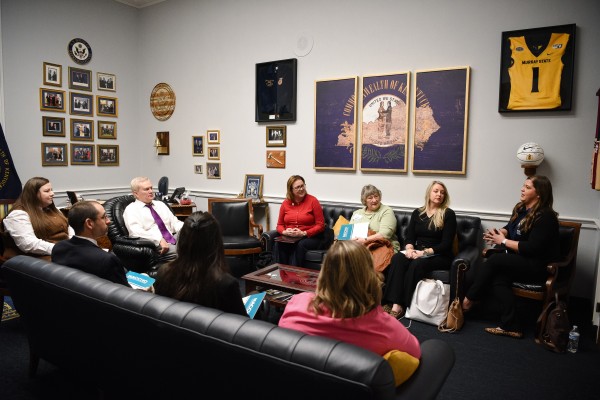
NACCHO was proud to convene more than 100 local public health professionals from across the country in Washington, DC last week for our annual Local Public Health on the Hill event. Throughout the day, public health leaders met with 140 Congressional offices to share firsthand stories about the challenges and successes of protecting community health. A central part of these conversations was expressing gratitude to Congress for providing responsible FY26 funding for federal public health agencies. This investment supports critical programs that help communities prepare for emergencies, prevent disease, improve health outcomes, and promote overall wellbeing.
At the same time, attendees emphasized that to continue meeting the needs of communities facing a variety of public health threats, sustained and predictable federal funding for FY27 is essential. Local health departments remain on the front lines of infectious disease response, chronic disease prevention, maternal and child health, and countless community services. Reliable federal investment ensures they can plan, build workforce capacity, and deliver high‑quality services every day. Responsible and reliable funding from federal public health agencies—particularly CDC—is critical to the nation’s public health capacity. Approximately 80% of CDC’s budget goes out the door to support the work being done by health departments. Local health leaders identified the need for the strongest possible funding for CDC’s Public Health Infrastructure and Capacity Program and asked Members of Congress to support an annual appropriation of $1 billion in FY27. Public Health Infrastructure funding allows local health departments to focus on certain skillsets that are critically necessary like communication, outreach, data analysis, and digitalization. With a stronger, sustained investment in local public health infrastructure, local health departments can ensure they have the professionals, systems, and essential skillsets needed to support federal public health goals including preventing and reducing instances of chronic disease and substance abuse.
Participants also highlighted the vital role of the public health workforce, which continues to face challenges recruiting and retaining staff. Local public health leaders asked Congress to support NACCHO’s request for an annual appropriation of $100 million to start and sustain the Public Health Workforce Loan Repayment Program in FY27. By investing in the workforce, Congress can help ensure that local public health saves lives and supports a physically and economically healthy community. Local health officials also asked for support of report language that directs CDC to better ensure funds reach local health departments and track where federal funds go after being sent to the state level.
Local Public Health on the Hill is designed to amplify the voices of those who understand community needs best: the local public health professionals doing the work. This year’s turnout—one of our largest yet—underscores the growing momentum behind local public health advocacy. Participants brought energy, expertise, and a unified message about the importance of a strong, well‑funded local public health system.
NACCHO is deeply grateful to the local health officials and staff who traveled to Washington, DC to represent their communities. Their voices and leadership continue to shape a healthier, more resilient nation. The conversations sparked during this event are only the beginning. NACCHO will continue working alongside our members, partners, and federal leaders to secure the resources and policies needed to support local public health.
---------
Read more about our members’ experiences participating in Hill Day and why local public health advocacy is important.

Katherine Wells, MPH – Director, Lubbock Public Health and NACCHO Board Member
NACCHO: Why are events like Hill Day and speaking directly with elected officials important for advancing public health priorities?
Wells: What struck me this year was how many of the staff we met with simply didn’t know about public health, not because they weren’t bright or dedicated, but because no one had ever connected the dots for them between federal policy and what happens in communities. That’s our job as local governmental public health leaders, and Hill Day creates the space to do it. Elected officials and their staff are making decisions about funding that affect real people, and they need to hear from constituents who can ground those decisions in reality. I was able to share the story of a young woman who had just graduated from high school and needed hepatitis C treatment before enlisting in the Army. Our department could help her because of a new funding stream we accessed — and we could access that funding stream because the Public Health Infrastructure Grant allowed us to hire a grant manager in the first place. That chain of impact doesn’t tell itself. We have to show up and tell them.

(pictured left) Meenakshi G. Brewster, MD, MPH, FAAFP – Health Officer, St. Mary’s County Health Department and NACCHO Board Member
NACCHO: What would you say to other public health professionals to encourage them to get involved in events like Hill Day?
Dr. Brewster: Getting involved in advocacy like Hill Day is one of the most impactful ways public health professionals can extend the reach of their work beyond their own communities. Our elected officials are responsible for setting funding levels and policies that directly affect local health departments’ capacity to protect and promote health in our communities, yet many of them have never heard firsthand from someone working on the ground.
Policymakers want to know what’s happening in communities in real time, and who better to tell them than those of us doing the work every day. Advocacy isn’t just about asking for resources; it’s about educating decision-makers on how federal policy and funding affect health outcomes locally and ensuring that public health practice is rooted in evidence and real-world needs.
Local health departments are both the backbone and boots-on-the-ground of public health in America. Keeping our elected officials informed about how federal resources and policies impact local public health work is essential to protecting our communities.
(pictured right) Amanda Oppler, JD, MPH - Health Policy Analyst II, Division of Community Engagement & Policy, St. Mary’s County Health Department
NACCHO: What motivated you to participate in Hill Day this year?
Oppler: What motivated us to participate was the opportunity to elevate St. Mary’s County’s public health priorities directly to the people who hold the pen on policy and funding decisions. For a rural county like ours, it’s especially important to take advantage of advocacy opportunities and the resources NACCHO provides for us. In addition to advocating for NACCHO’s national priorities, Hill Day allowed us to ensure that our local experiences, strengths, and challenges were visible at the federal level. We wanted to build relationships with our delegation, share concrete examples of how federal policies translate into community health outcomes, and advocate for sustainable support for core public health functions. Participating in Hill Day is a strategic investment in the future of public health and it’s so important that our rural county’s needs are represented and that our voices are heard.

Damōn Chaplin, MBA - Health Commissioner, City of Minneapolis Health Department and NACCHO Board President
NACCHO: Why are events like Hill Day and speaking directly with elected officials important for advancing public health priorities?
Chaplin: Events like Hill Day allow us to share the stories and impact public health programs have on our communities. This interaction is especially imperative during a time when public health funding is at risk. Much of the preventive work done in public health is invisible until a crisis occurs. Through conversations with our elected officials, we can raise awareness about the work and make it a priority.
NACCHO: What would you say to other public health professionals to encourage them to get involved in events like Hill Day?
Chaplin: Advocacy outreach is the key to keeping the conversation going around public health and keeping it top of mind. To maintain momentum in public health priority areas like substance use prevention programs, mental health, infectious disease prevention, and more, advocacy outreach at every level is needed. These efforts help inform, influence, and mobilize support in policy adoption and funding.