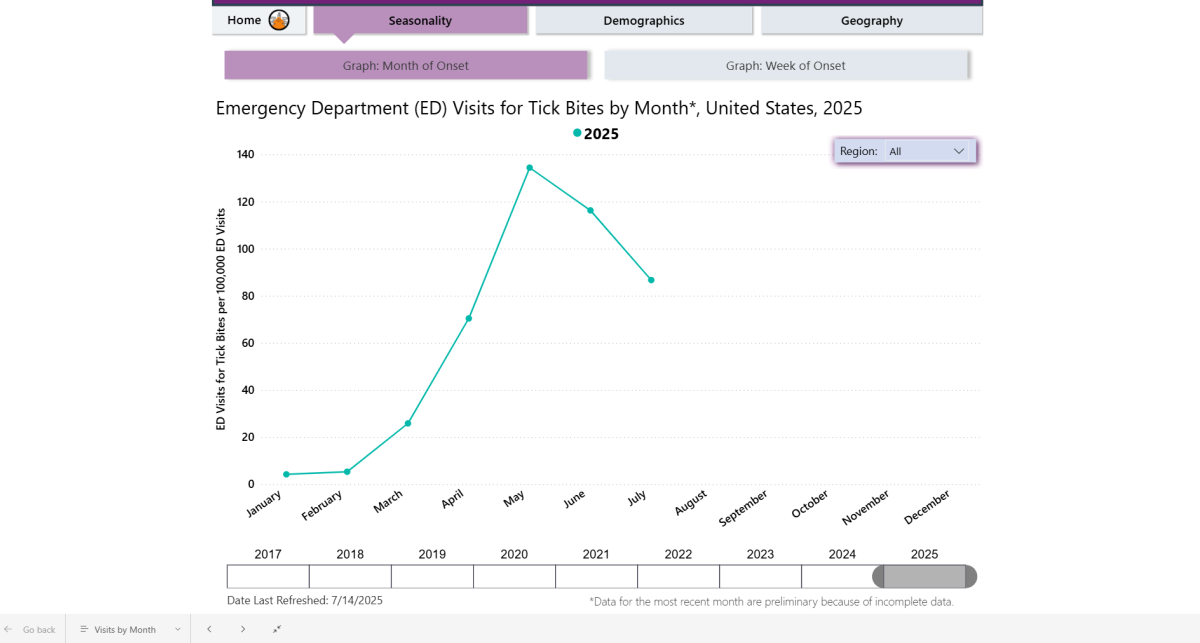
CDC’s Tick Bite Tracker notes rise in Emergency Department visits in May and June 2025. (Image: Screenshot of CDC’s Tick Bite Tracker)
In response to the Centers for Disease Control and Prevention’s (CDC’s) Tick Bite Tracker noting an increase in emergency department (ED) visits attributed to tick bites in 2025 (and again in spring of 2026), NACCHO compiled the following resources for health departments to use and share with their communities as part of tick bite prevention and tick control efforts.
In 2025, Boston.com had noted that 2025 “summer spikes are the largest in at least five years in the Northeast.”
*Update* CDC’s Tick Bite Tracker showed that weekly rates of ER visits for tick bites were the highest in April of 2026 since 2017, in all regions except the South Central United States.
See CDC’s tracker data here.
For the Public
Encourage the public to reach out or send ticks in for testing to your local health department. Have capacity for in-house testing? LHDs can promote NACCHO’s Local Health Department Directory as a resource for the public to reach out, send ticks for testing, and to get their questions and concerns answered.
CDC’s Information Hub on Preventing Tick Bites: Families can take several steps to prevent tick bites, using free information provided by the CDC. This webpage also features a free tool to help the public choose the best insect repellant for their needs. Also, see CDC’s webpage for steps to take after a tick bite. We also recommend Cape Cod’s Barnstable County’s excellent website for tick bite prevention aimed at the public.
Get ticks out with ease with Bug Bite Thing (formerly Tickease, Inc.)! The public can purchase this specialized tick removal tweezer to add to their first-aid kit. This product has been approved by members of NACCHO’s Vector Control workgroup. See how to use it here, including helpful tick identifier tips aimed at public education.
Or see CDC’s video here about general tick removal guidelines.
Become part of the effort to understand the risk of tick-borne diseases.
- TickApp is a community-based science smartphone app developed jointly by Vector-Borne Disease Center of Excellence researchers in the Midwest and Northeast that can help inform people about tick safety and help contribute to human-tick encounter surveillance data. Data collected from TickApp allows researchers to create a map of where the encounters occurred and beta-test simple tick identification methods for further educational use.
- Cape Cod’s Barnstable County shared another public identifier app for ticks, TickSpotters, a free service run by the University of Rhode Island.
For Multiple Audiences, Including Public and Health Professionals
Recommend a late summer reading list: People can now visit the virtual VECTOR Library, developed by the VectorED Network (a CDC Training and Evaluation Center) and Penn State Extension, aimed at providing researchers, educators, public health officials, veterinary professionals, healthcare providers, at-risk individuals, and the public with essential educational, training, and communication resources, developed by subject-matter experts. It’s a catch-all for all things ticks and mosquitoes!
Tick Management Handbook: An integrated guide for homeowners, pest control operators, and public health officials for the prevention of tick-associated diseases: A general guide by the Connecticut Agricultural Experimentation Station for the public, pest control operators, and public health officials. Implementation of some of the concepts presented in this handbook can reduce ticks and the risk of Lyme disease.
For Local Health Departments
*New* CDC’s No Time for Lyme Campaign Communications Assets: To support local-level tick prevention outreach efforts this year, please see two new social media assets here and here from the CDC to help local health departments remind the general public to check for ticks.
This Tick Surveillance Toolkit, developed by the CDC, contains informational documents on the surveillance of different tick species and the pathogens found in those species within the United States. Also included in this toolkit is a scripted slide set on Tick Surveillance as a Public Health Tool, Ixodes scapularis guidance, and Ixodes pacificus guidance.
Tick Article Collection: The Journal of Medical Entomology published a special collection of forum articles on the rise of ticks and tick-borne diseases in the United States. The articles were written by leaders in the field and highlights key accomplishments, significant information gaps, insights into trends and drivers, and identification of high priority needs.
Tick Report: LHDs can reach out to vendors such as Tick Report for subsidized funding options on tick testing and reporting.
Looking to buy new vector control equipment this tick season? Crunch the numbers with our cost analysis tool! Get a breakdown of expenses, labor, and other associated costs that may come with a new purchase using NACCHO’s free downloadable tool here. Instructions for use are provided in the worksheet.
CDC’s Communications Resource for Preventing Tick Bites: An LHD’s one-stop-shop to download and promote free educational materials for the public.
Want to connect with your vector control peers? Join and start using NACCHO’s online virtual community to check in and get the support you need. You will need your MyNACCHO.org account to join.
For additional resources on tick control, reach out to [email protected].
This blog post was last updated May 2026.