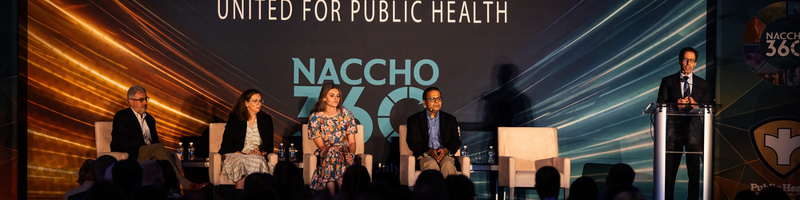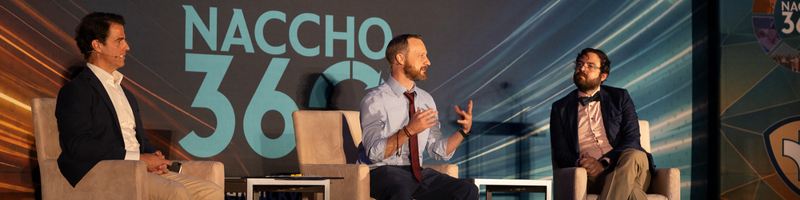
Following a morning round of educational sessions, day two of the 2026 NACCHO360 conference opened with a keynote address and plenary session.
As keynote, Dr. Jerome Adams, Executive Director of Health Empowerment Initiatives and the Center for Community Health Enhancement and Learning at Purdue University, shared his journey as a child suffering from asthma and the associated hospital visits to a career in healthcare, including serving as the 20th surgeon general of the United States. Adams noted that health is not about morality; public health nowadays can be about fiscal responsibility. He spoke of the ability to advance public health in turbulent times by quantifying the costs of preventable illnesses and diseases. Talking about the illness and disease costs may resonate with funders and policymakers across both sides of the aisle.
Adams advised identifying and collaborating with trusted messengers like physicians, nurses and pharmacists; partnering with trusted community voices; moving to value-based care versus volume-based care; transitioning from transactional interactions to more empathy-based, community interactions; and leveraging AI and technology as a force multiplier for public health. He also encouraged attendees to celebrate and talk about the progress they have made.
“Be the change,” said Adams. “You are the stewards of a system under strain but also the architects of what comes next. The opportunities are greater than the challenges.”
Public Health 2031: The Future We Choose—and What It Takes to Get There
Brian Castrucci, President and Chief Executive Officer at de Beaumont Foundation, served as moderator for the panel discussion, “Public Health 2031: The Future We Choose—and What It Takes to Get There.” He spoke to public health’s role in increasing life expectancy by 25 years while also being ridiculed and experiencing pushback. He noted that public health is good at cataloging the problems and encouraged attendees to be ready to focus on the solutions to shape the future of public health. “With the reductions in staff and in funding, we can’t do everything,” he remarked. He called for prioritization of communications and thoughtful approaches to AI.
Amelia Burke-Garcia, Director of the Center for Health Communication Science at NORC, noted a need to revolutionize how we communicate about health and pointed to opportunities for AI to help public health professionals do that. She encouraged attendees to invest in AI and use AI to serve people better, to do more with less, to reach people as an effective communications tool, and to use it as a data analysis tool. “It’s a game changer,” said Burke-Garcia in creating better communications content that “will meet people where they are and will meet the moment.” She also highlighted the need for content to be findable and searchable by AI chatbots because if public health content is not findable and searchable, it is not in the game. “We must embrace all of the resources, including AI, that we can use to get better health results,” said Burke-Garcia.
Chelsea Cipriano, Managing Director at Common Health Coalition, focused on the value of partnerships, saying that they may “feel squishy,” but when we think about all of the public health achievements, we realize we did them with colleagues. She called on public health to develop a collective vision for the future, starting by taking off “the invisibility cloak” and showing the “receipts” of the work we do as a means of being accountable to taxpayers. Cipriano encouraged attendees to look for the low hanging fruit—things that people care about and can see (the potholes)—and to fix them. As highlighted by other panelists, she spoke of the value of communications, and the role AI can have in ensuring local public health is part of conversations among key audiences. Cipriano reinforced her message by talking about the need to focus on and start with the problem rather than the tools. “Let’s identify our potholes, identify our partners, and identify our plan to get the work done for the health of our communities,” said Cipriano.
Katrina Forrest, Executive Director of the CityHealth initiative at de Beaumont Foundation, talked about the need for public health to be seen as an indispensable governing partner, calling on a shift of focus to creating public value and becoming better advocates. She encouraged attendees to ask elected officials what their priorities are, congratulate them on their wins, and serve as a resource for issues that officials care about. Forrest pointed to the key role that staff play as anchors in long-term influence and the need to show up and be of service to them. She called on attendees to connect with someone outside of public health and ask three questions: what keeps you up at night; what are you struggling with and how can I help; and what support can I provide to help you achieve success.
Jessica Malaty Rivera, Executive Director at Public Good Projects, spoke to the need for public health to make sense to the public by leveraging trusted messages from trusted messengers in a way that is understandable to people in the community. She contrasted public health’s approach to communications with that of the wellness industry and emphasized that people are compelled by emotional and emotive messages. Rivera encouraged attendees to self-identify as neighbors and community members in their outreach and to proactively and regularly have meetings with local religious leaders, influencers, and community groups.
Moderator Castrucci wrapped up the plenary with a call to action. “Leaders don’t wait for the future or just react to the future. True leaders build the future. This is our public health challenge to build the public health system that America deserves.”
Additional Highlights from Day Two
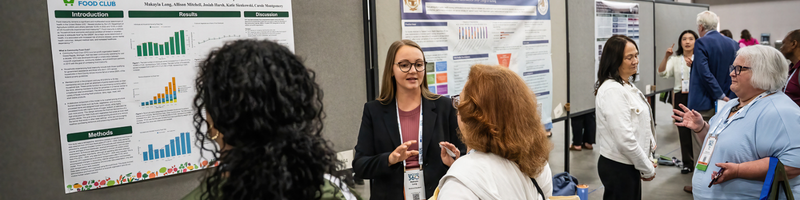
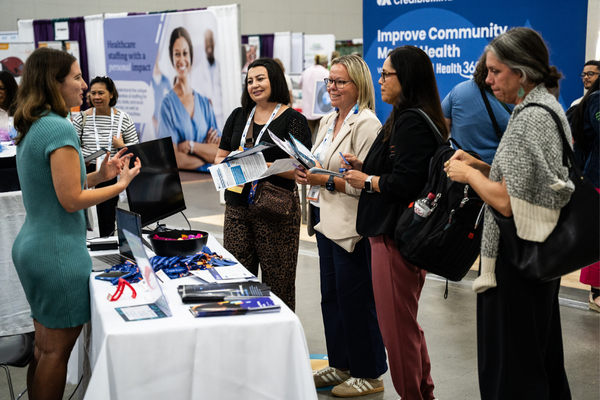
In addition to the plenary session, day two of NACCHO360 included more than 90 educational sessions. Over lunch in the Exhibit Hall, registrants also had the opportunity to learn from and interact with 40 posters and their presenters.