Emergency Department-Based Substance Use Response
This page requires a membership login. Log in or create an account by clicking the link below.
MyNACCHO LoginThe National Association of County and City Health Officials (NACCHO) recognizes that hospitals and emergency departments (EDs) play a critical role in the medical treatment of a patient following a non-fatal overdose and can be an important venue to engage patients in a conversation about their substance use and provide connections to services or further treatment. With support from the Centers for Disease Control and Prevention (CDC), NACCHO has worked on a variety of projects and resources that focus on ED-based overdose prevention programs.
This webpage will serve as a resource hub on this issue, providing information, resources, and tools for local health departments and their health system partners seeking to build their capacity to integrate and support peers in emergency department settings.
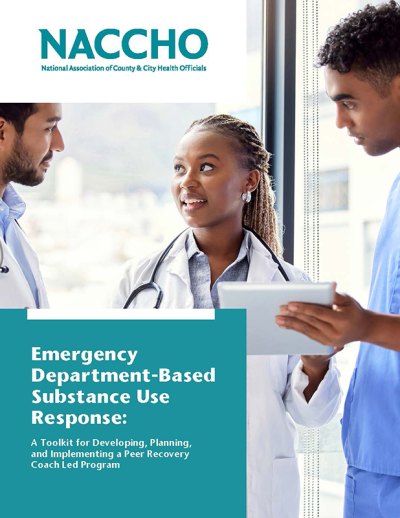
NACCHO is pleased to announce the release of a new resource: Emergency Department-Based Substance Use Response: A Toolkit for Developing, Planning, and Implementing a Peer Recovery Coach-Led Program. This comprehensive tool for health systems and their partners, including state or local health departments, provides a guide to the development of peer-led, ED-based programs aimed at identifying and empathetically engaging people who drugs to provide education and drive linkages to medication for opioid use disorder (MOUD), treatment, harm reduction, and other behavioral or social services to improve patient outcomes.
Working collaboratively with the Mosaic Group and CDC, this toolkit was developed as a step-by-step roadmap that covers evidence-based options for care in the ED, practical strategies for integrating these options, and real-world case studies. At its heart lie four main practices:
- Systemization of universal screening to proactively identify people at risk of overdose.
- Integration of peer recovery specialist into the care team. Peer recovery specialists' lived experience makes them trusted messengers with whom patients are more likely to engage in conversations about their substance use.
- Development of procedures to ensure that interested patients are induced on MOUD during their stay in the ED.
- Establishment of robust community partnerships to ensure continuing care for patients post-discharge.
NACCHO has worked with local health departments and hospitals throughout the U.S. to implement and support peer-led emergency department programs. These projects include:
- ED-Based Substance Use Navigation - Advancing the Evidence
- Embedding Peers in Emergency Departments (EPED)
- Sustaining Peers in Emergency Departments (S-PED)
- Reverse the Cycle Hospital Demonstration Sites
West Virginia
Mon Health Medical Center
Morgantown, WV
Year: 2020
Learn more on Reverse the Cycle Hospital Demonstration Sites
West Virginia
Mon Health Stonewall Jackson Hospital
Weston, WV
Year: 2020
Learn more on Reverse the Cycle Hospital Demonstration Sites
| Name | Address | Details |
|---|---|---|
| Mon Health Medical Center | Morgantown, WV |
Year: 2020
Learn more on Reverse the Cycle Hospital Demonstration Sites |
| Mon Health Stonewall Jackson Hospital | Weston, WV |
Year: 2020
Learn more on Reverse the Cycle Hospital Demonstration Sites |