Suicide Prevention
This page requires a membership login. Log in or create an account by clicking the link below.
MyNACCHO LoginThe National Association of County and City Health Officials (NACCHO) recognizes that local health departments (LHDs) play a critical role in suicide prevention.
NACCHO Expands the Community-Based Suicide Prevention for Local Health Departments Online Course
With support from the Centers for Disease Control and Prevention, the National Association of County and City Health Officials (NACCHO) is excited to announce the expansion of its Community-Based Suicide Prevention for Local Health Departments online course. This free, self-paced training has been enhanced with new content, tools, and practical exercises to help local health departments build and sustain comprehensive, community-based suicide prevention efforts.
Now featuring five modules and approximately 4 hours of content, the course helps learners build skills in the following areas:
- Module 1: Strengthening Suicide Prevention Infrastructure
- Module 2: Building and Sustaining Cross-Sector Suicide Prevention Partners
- Module 3: Supporting Upstream Comprehensive Suicide Prevention
- Module 4: Promoting Lethal Means Safety
- Module 5: Organizing Response and Support After Suicide Attempts and Loss
The expanded course includes a new module on suicide prevention infrastructure and offers deeper guidance on upstream suicide prevention strategies, with examples of evidence-informed programs, policies, and practices for local health departments. Learners will explore hypothetical scenarios and interactive exercises designed to build confidence in identifying, assessing, and selecting prevention strategies that fit their community context.
In addition to videos, practical tips, new real-world examples from local health departments, and action-oriented guidance, the course includes a growing collection of downloadable tools and resources, including:
- The Upstream Suicide Prevention Strategy Match Cheat Sheet – a practical reference guide to help local health departments identify appropriate upstream strategies, approaches, and next steps based on their goals, partners, and community needs.
- Suicide Prevention Core Competencies for Local Health Department Staff – a framework that organizes essential suicide prevention competencies across multiple categories and three levels of career progression, helping staff identify opportunities for professional growth and capacity building.
Whether you are new to suicide prevention or looking to strengthen existing efforts, this course provides practical guidance and resources to help turn learning into action. While designed for local health department staff, the content may also be valuable to a broad audience involved in community suicide prevention, including suicide prevention coalitions, behavioral health organizations, schools, healthcare providers, and other community partners.
Start learning today! Use or create a free MyNACCHO login to access the course. For questions about the course, please contact NACCHO's Overdose, Injury, and Violence Prevention Team at [email protected].

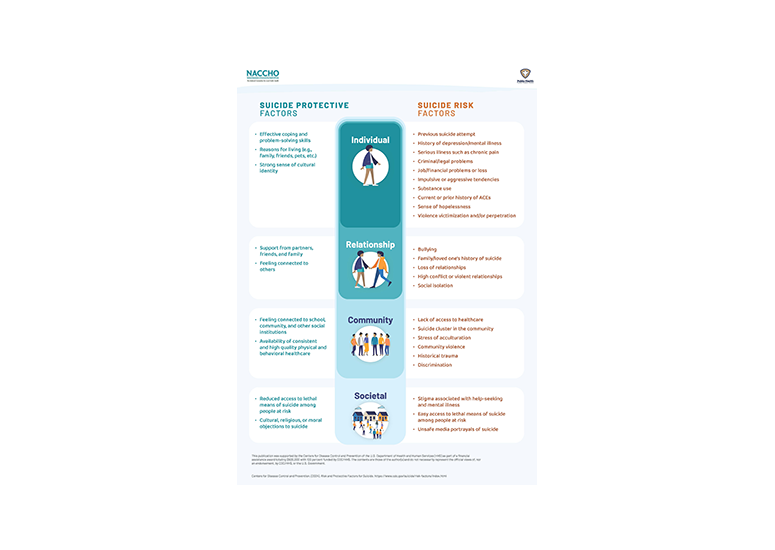
NACCHO has worked with local health departments and their partners throughout the U.S. on projects that focus on suicide prevention. These projects include:
- Expanding Community-Based Suicide Prevention Projects (ECSP)
- Suicide, Overdose, and Adverse Childhood Experiences (ACEs) Prevention Capacity Assessment Tool (SPACECAT) Planning and Implementation Projects
Stay connected to NACCHO’s suicide prevention work and receive updates on funding opportunities, resources, and events by joining the Suicide Prevention Mailing List. If you are interested in joining NACCHO’s Suicide Prevention Mailing List, please login to MyNACCHO. Once you are logged in, visit "My Subscriptions" and then select the box next to the newsletter titled "Suicide Prevention Newsletter."
If you do not have a MyNACCHO account, you can quickly create a free one by following the steps here. Please reach out to [email protected] with questions.