Introduction
Public Health is simultaneously under-resourced and facing a technological revolution. Generative AI is changing public health at a foundational level by providing new ways to write, analyze data, connect, explore, and create. These new AI-powered capabilities also bring many new challenges. As local public health jurisdictions, the question is not whether to engage with AI, but how to do so responsibly.
Ohio’s local health districts (LHDs) are working on this issue through the development of a statewide AI taskforce organized through the Association of Ohio Health Commissioners (AOHC). In February 2026, the AOHC taskforce released a statewide survey on AI use by Ohio LHDs in an effort to gain insights into where LHDs are in AI adoption, where gaps exist, and where future efforts will be needed. This survey included 26 questions, and addressed issues related to governance, policy, AI tool use, training, workforce concerns, and other aspects of AI implementation.
Here is what we found.
AI Use is Common but Ungoverned
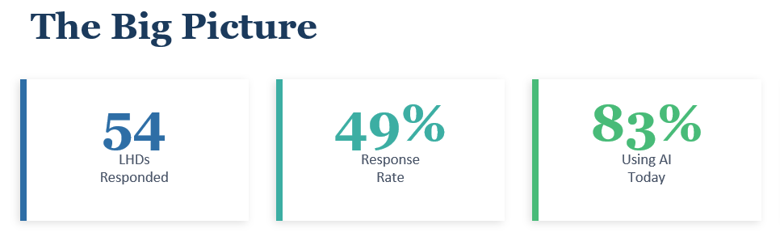
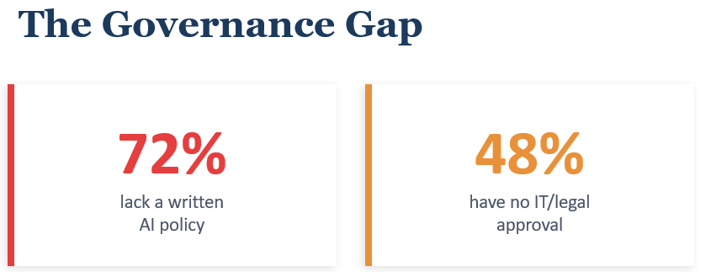
54 out of 111 Ohio LHDs responded to the survey, representing 49% of the state. 83% reported known AI use at their LHD, while only 28% reported having a written AI policy in place. 48% reported having no formal IT or legal approval for AI use. This gap between AI use and policy widens with LHD district size, with smaller LHDs being less likely to have formal governance in place.
Training is Needed
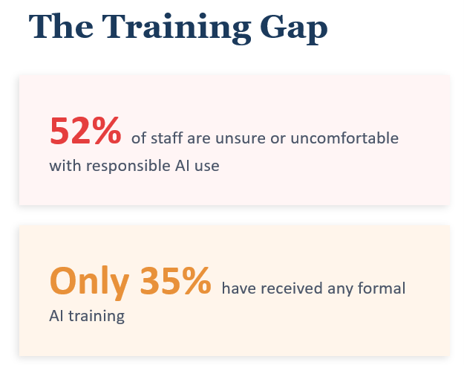
52% of agencies reported that staff felt “Unsure” or “Uncomfortable” about using AI tools responsibly. 65% of agencies reported receiving no formal training for AI use. Formal AI training rates drop to 25% for our LHDs representing districts of 50,000 people or less, again demonstrating greater AI gaps in smaller jurisdictions.
LHDs Understand the Risk, but Need Support
93% of LHDs reported that AI tools were not permitted to be used for sensitive or protected data, representing a strong understanding of some of the fundamental risks associated with many generative AI tools. At the same time, LHDs reported the most interest in trainings that demonstrate practical AI use cases for public health. Additionally, when LHDs were asked “Who currently makes decisions about AI use in your department?”, 33% reporting having no clear decision owner identified. With a third of LHDs reporting no clear AI decision owner, many LHD staff are facing these new AI risks without the necessary organizational support.
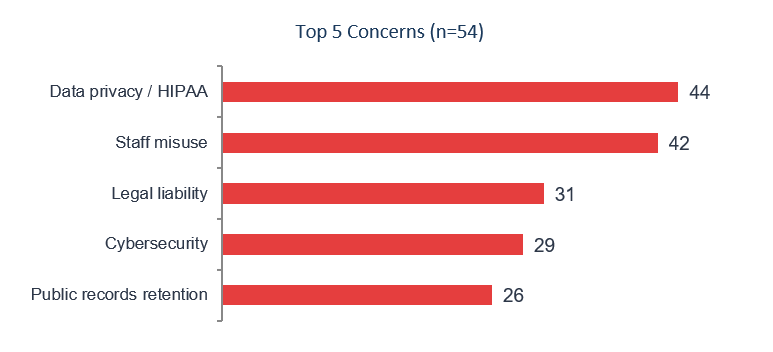
What concerns does your department have about AI use? (Select all that apply)
Filling the Gaps
This statewide survey revealed several gaps in governance, policy, and training at the local level. These gaps widen as jurisdictions get smaller. Smaller jurisdictions, who in many cases are the most resource-challenged health districts in Ohio, are also the least likely to have implemented AI into their workflows. This represents a significant opportunity for small jurisdictions to find efficiencies, bridge resource gaps, and better serve their communities through the use of these new technologies.

Ohio’s Plan of Action
In response to these gaps in AI readiness and implementation, AOHC’s AI taskforce has developed a plan to address these issues.
- Launching a statewide AI training initiative. Three virtual training sessions were held on AI frameworks, AI functions and implementation, and real-world AI projects. These training sessions brought in national level experts to help train LHD staff at all levels. Over 450 attendees participated in these training events.
- Developing Ohio-specific draft policy templates. Ohio law contains state-specific record keeping requirements, data protection laws, and other legislative mandates that can influence AI use. Additionally, multiple bills are being proposed currently that may further impact AI use in government settings. An Ohio specific policy template is being developed to support local agencies as they develop policies and framework for AI use.
- Creating an AI platform analysis tool to help LHDs review and measure AI resources and vendors. LHD leadership is regularly approached by vendors who are promoting AI powered tools. This AI platform analysis tool will support LHDs as these tools are evaluated for security, ethical considerations, cost, and other factors.
- Providing LHDs with AI tools as part of a statewide pilot project to increase staff access and comfort level with this technology. Most LHDs that have implemented AI tools into their workflows use free tools. These free tools are often limited in ability, scale, and usage, and present potential additional security risks. AOHC is developing a pilot project that will allow users at every LHD in Ohio to interact with paid AI tools. This will improve safe and ethical exploration of AI tools locally, building a foundation of AI capacity at the local level.
- Developing AI-centered special projects to explore responsible AI integration into public health workflows. Some existing statewide public health projects are well positioned to have AI tools incorporated into their processes and workflows. AI tools will be incorporated into these projects in order to improve utility, efficiency, and use by LHDs in Ohio.
Conclusion
The public health workforce is not waiting for permission to use AI. This requires organizations to respond to AI use as an urgent infrastructure need, rather than a theoretical challenge. As public health leaders, we must develop policies, training, and systems to support responsible and ethical AI use.
Contact
If you are part of a similar taskforce in your area, we would love to talk to you and learn more about what you are working on. Contact Jared [email protected] or Melanie [email protected] to connect!