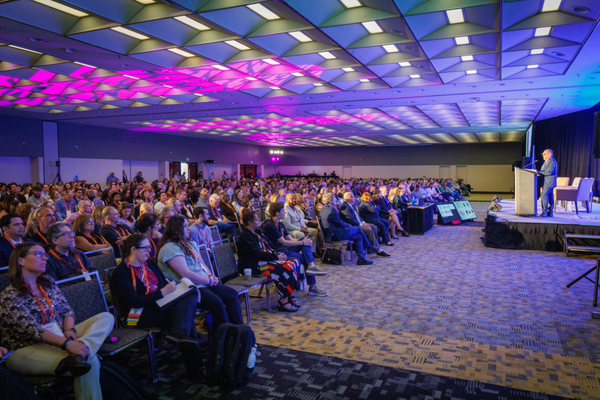
On Monday, April 13, the 2026 Preparedness Summit opened in Baltimore, with over 2,000 attendees participating in-person and virtually.
Kick Off to the 2026 Preparedness Summit
In welcoming attendees to Baltimore, Damōn Chaplin, Commissioner of the Minneapolis Health Department and NACCHO President, noted that preparedness is not abstract work—it shows up in the relationships we build before a crisis, the systems we strengthen every day, and the trust we earn long before an emergency ever occurs. He called on attendees to use the conference as a space to “reflect on what we’ve learned, to confront the challenges ahead, and to push ourselves to think differently about how we lead, plan, and respond in an increasingly complex world.”
Dr. Michelle Taylor, Commissioner of Health at Baltimore City Health Department, commended the ability of local health departments to be able to talk to each other in times of uncertainty, stressing that no matter what is happening at the federal level, staff at the state and local level remain stalwart in their mission, caring for the health of the public.
Laura Biesiadecki, Preparedness Summit Planning Committee Co-Chair and Senior Director of Preparedness at NACCHO, highlighted the theme for the conference and how the plenary sessions during the week relate to it. She noted that, “regardless of discipline, jurisdiction, or the threats we face, our work rests on one truth: we get by—with a little help from each other. And in the hardest moments, we don’t just get by. We lead; we support; we adapt; together.” She stressed that conversations at the conference would be the beginning of a national dialogue on the evolution of preparedness and called on attendees “to think, engage, and most importantly, to share throughout the week.”
Dr. Henry Walke Director, Office of Readiness and Response at the Centers for Disease Control and Prevention, reiterated the agency’s commitment to state, local, tribal, and territorial (STLT) partners, walking the audience through current federal investments in bio-surveillance and epi-intelligence, AI, and more. Dr. Walke assured coordination across federal agencies and with STLT partners to ensure laboratory support, threat detection, and mass gathering public health preparedness guidance ahead of the 2026 World Cup. Dr. Walke ended his remarks with a call to action to use the Preparedness Summit as “an opportunity to bring hard truths, ask tough questions, and walk away with practical, implementable steps for emergency preparedness.”
Opening Plenary Session
The opening plenary session, Stronger Together: Evolving Models of State and Local Collaboration, focused on new and emerging models for state and local collaboration between the public health, healthcare, and emergency management sectors.
To set the context for the conversation, session moderator Jack Herrmann, Senior Director, Client Programs at the American Red Cross-National Headquarters, highlighted that challenges including floods, storms, wildfires, and disease threats are not isolated challenges; they are overlapping and compounding. Likewise, “preparedness is not something that any sector or level can do independently, collaboration matters.” He called on attendees to consider their own environments, taking note of where collaboration is strong, where it is fragile, and what it would take to strengthen it.
Dr. Taylor emphasized the importance of collaboration and communication, as well as data sharing across sectors, so that all agencies are able to respond quickly, flood the community with information, resources, and save lives during an emergency.
Dr. Paul Biddinger, Chief Preparedness and Continuity Officer at Mass General Brigham, stressed the importance of partnerships between healthcare and public health preparedness underpinning capacity to capability. He underlined the importance of public health stories—stating that the workforce always does what it takes to keep our communities safe and healthy, making it a matter of national security but emphasizing that “we need to do a better job of telling these stories to the public on a daily basis.”
Sara Barra, Director of the Office of Preparedness and Response at the Maryland Department of Health, highlighted the need to both know the big picture—knowing where authorities are and what you can and can’t do—and to build preparedness into everyone’s day-to-day work. She shared how cross-training across the department and sectors has allowed staff to work to the best of their skillsets and capabilities. “We can’t do all things, but we can do all things together,” she remarked.
Matt Cowles, Deputy Director at the National Emergency Management Association, talked of the disruptions happening at the federal level and how they impact day-to-day work in communities. He noted the role that the Emergency Management Assistance Compact (EMAC) can play in responses across states and the opportunities it presents in the future. Cowles also emphasized that “we are not just facing public health problems or emergency management problems; we are facing whole-of-community problems that are very complex and can be hard to get our hands around.”
The plenary presented closing questions for the audience to consider during the duration of the Summit:
- What partnership structures in your organization are truly embedded, which ones do we depend on, and which have individual or short-term funding?
- Where are tensions being avoided rather than addressed, and what would it take to work through them productively?
- What is one practical step you can take in the next year to strengthen collaboration as a sustained capability and not just a response tactic?
Additional Highlights from Day One
In addition to the keynote session, day one of the Preparedness Summit included over 40 demonstrations, learning sessions, and workshops. The day concluded with a late-breaking session, “Federal Preparedness in Transition: Updates on the Evolving Policy Landscape,” which provided a timely overview of the current federal landscape affecting public health preparedness, covering recent executive orders and key federal funding streams.