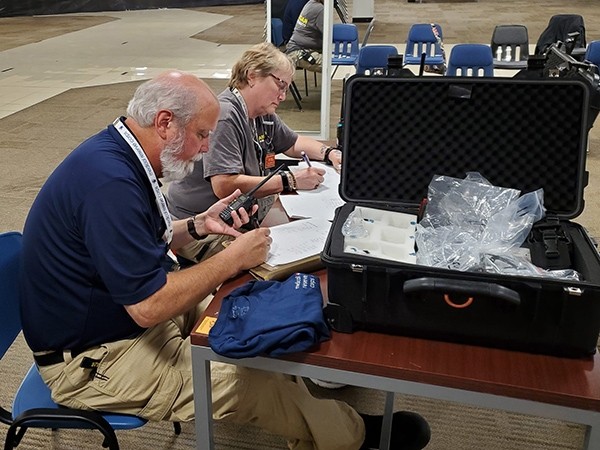
HAM radio (also known as amateur radio) can provide critical communications capability in the event of an emergency impacting telecommunications or internet connectivity. Medical Reserve Corps (MRC) volunteers trained and licensed as HAM operators can use their skills and equipment to provide connection to unit leaders, between volunteers, and with emergency response personnel within the community.
Ventura County MRC (CA)
The Ventura County MRC in California is working to have a volunteer trained as HAM radio operator in each town to create a connected web of people across their county. Home to about 850,000 residents, the county ranges from low lying coastal areas to high mountain ranges.
“If communications go down, this is a way for volunteers to reach the unit leader or EMS,” said MRC Program Administrator Traci Holt. “It also helps volunteers know how and when to respond in the event of deployment.”
In addition to adding to the unit’s functional capabilities in the event of an emergency, Holt sees HAM radio as a fun team building activity to engage and inspire volunteers. It’s also cost effective.
The unit used funding from NACCHO’s Operational Readiness Awards to purchase 30 HAM radios at a cost of $30 each and 30 training books, which support volunteers in passing an FCC test to obtain a HAM radio license. The unit asks volunteers to cover the cost of their license ($35) and, once they show proof that they have a license, volunteers can check out radios as they would other specialized PPE.
To help generate interest in this new skill, a member of the local amateur radio club came to speak to volunteers. Several champions within the unit have been identified and volunteers went through the first module of the training together during a monthly MRC meeting.
To help make this a fun activity, the unit will use competitions like a Lego building challenge and trivia with hospitals/trauma departments to exercise HAM radio capabilities.
“The goal is to have monthly check-ins as a unit or with the local amateur radio club,” said Holt. “We’ll see if we can get a message through from low lying areas to the high mountain range within the county.”
Dutchess County MRC (NY)
A volunteer Radio Team has been part of the Dutchess County MRC in New York for several years. Volunteers often use tactical radios during events and for crowd monitoring. Use of the tactical radio frequency does not require licensing or have as many protocols for use as HAM radio. In addition to its utility, operating a tactical radio serves as a way for volunteers to get comfortable communicating via radio.
Currently 25 volunteers are also licensed as HAM radio operators and the unit is working to develop more interest in HAM radio for use in emergencies.
“We’re in a very large county geographically,” said Lynn Rightmyer, a Radio Team lead. “If there’s a disaster in which internet and cell service go down, HAM will be the backbone. It can be used to relay availability of hospital beds and serve as a backup for EMS.”
To practice this capability, the unit hosted an exercise at a former JC Penny store, a space the county had rented for use during COVID-19 response. Cards were placed around the store and teams with radios worked to find the cards and relay the corresponding numbers at each station. In September, the unit is planning to set up stations where each trained volunteer can practice broadcasting and find something.
The unit has also hosted soldering classes, which is both a fun activity and a skill volunteers can use in making their own radios.
Resource: Click here to see a mission set utilizing licensed HAM radio volunteers.