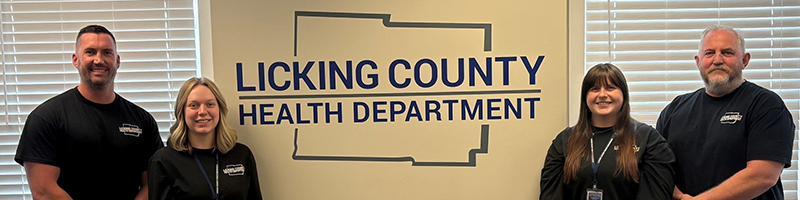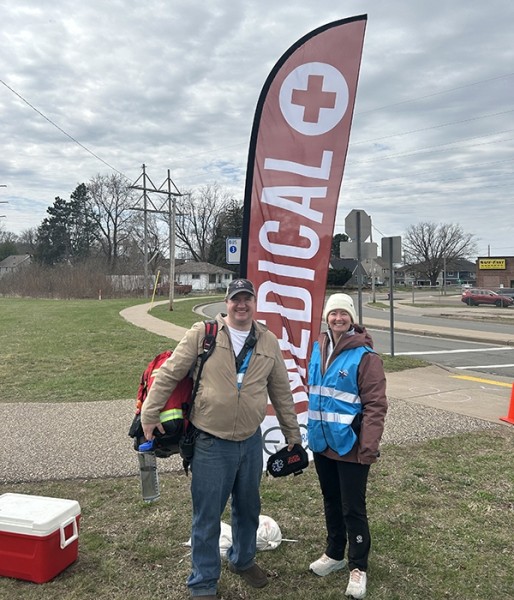
This month NACCHO highlights how two Wisconsin Medical Reserve Corps (MRC) units support emergency response and community preparedness capabilities.
Eau Claire County MRC
The 165 volunteers of the Eau Claire County MRC in Wisconsin have contributed over 400 hours of service this year, delivering a wide range of community services. The unit serves Eau Claire County which is home to approximately 108,000 residents, including both the city of Eau Claire and surrounding areas.
At least once each winter and summer, the unit is activated as part of the county’s extreme temperature plan. Volunteers support extended hours of operations for area shelters, covering staffing gaps on weekends and holidays. They provide a welcoming presence by checking in residents, helping with belongings, offering food and refreshments, and maintaining a safe environment. Each activation is typically supported by four to five volunteers, with two or more volunteers scheduled per shift.
The unit has also developed a mission set and capability around First Aid at community events. This capability was deployed for the Eau Claire Marathon and an air show which attracted over 45,000 people. One event day saw extreme heat and resulted in over 60 people going to the first aid tent. For such events, the unit reprograms its radios to connect directly with incident command personnel and other first responders on site.
“These activities have reaffirmed that the unit has the capability to support a variety of preparedness and response needs – including basic first aid, and that we’re capable of supporting other types of public health emergencies,” said Unit Leader Joe Kalscheur. “We have Standard Operating Procedures (SOPs) with our local Fire Department. While we may not take on the lead role, we remain committed to supplementing and strengthening our partners’ efforts in service to our public’s health
Each fall, unit volunteers provide support to several mass vaccination clinics. [These clinics help keep skills sharp and provide invaluable cross training opportunities with our health department staff and community partners. This year, they will also be providing surge capacity support for a new drive-thru clinic location.
In addition to supporting mass vaccination and drive-thru clinics, unit volunteers play an active role in community preparedness. This includes hosting an emergency preparedness workshop for older adults. Content for the workshop was developed by an intern who tailored materials from sources like Ready.gov and the Red Cross. The unit also hosts Stop the Bleed and CPR training as well as other preparedness workshops throughout the year.
One unit volunteer, who is Mennonite, became a Stop the Bleed instructor and led a course for the local Amish community attended by over 100 people. In May, the unit put on a lifesaving skills and preparedness workshop, which drew more than 40 attendees, including community partners, volunteers, and members of the public. Volunteers led a series of training courses throughout the day including Basic Life Support CPR, Stop the Bleed, and personal and family preparedness. A Narcan and opioid awareness training was provided by our health department We also partnered with a professor from a local university who presented on understanding and addressing the stress response.
To prepare for its missions, the Eau Claire County MRC holds meetings every other month, featuring training on various topics.
“We try to involve different partners and cover a mix of topics at MRC trainings and meetings to help volunteers gain knowledge, skills, and perspectives that can be applicable in future deployments and in their own lives,” said Kalscheur.
The unit also holds just-in-time trainings (JITT) before each event. When providing first aid support, JITT sessions are held with both volunteers and partner organizations. They also review key skills prior to each event. An annual POD training is held ahead of the fall mass vaccination clinics.
As the Eau Claire County MRC looks to its own operations in support of its capabilities, the MRC COVID-19 Respond, Innovate, Sustain, and Equip (RISE) Awards, provided by NACCHO with support from ASPR’s Office of the Medical Reserve Corps, “was critical.” With these funds, the unit was able to do a deep review and update of its handbook, policies and procedures, and its administrative systems. The MRC State, Territory and Tribal Nations, Representative Organizations for Next Generation (MRC-STTRONG) grant has helped the unit to maintain, strengthen, and advance operational capabilities, now being supported by the infrastructure built under the RISE award.
“These grants have allowed us to keep growing,” said Kalscheur. “We were able to build operational capabilities to better support our community’s needs, address other public health threats, and support resiliency throughout the community including Life Safety, CPR, Stop the Bleed, First Aid, and emergency preparedness capabilities. We also developed onboarding and workflows that we didn’t have previously.”
“It’s a humbling experience to be part of this work,” said Kalscheur. “Our MRC volunteers remind me of the humanity that exists in this world. It’s an honor to work alongside them in service with our community.”

Marathon County MRC
Marathon County MRC in Wisconsin is a new unit actively working to build its capabilities and volunteer base. Established in 2024, the unit currently has 12 volunteers. Marathon is a large county with 130,000 residents across 1,576 square miles (an area about the size of Rhode Island). The county includes farmland, a small city, and a diverse rural population. Its biggest threat stem from severe weather, including flooding and ice storms.
Last year unit leaders participated in month-long state of Wisconsin Recovery Exercise focused on flood response. This enabled staff to assess how the unit could assist during such emergencies and helped identify team needs, including supplies and equipment.
During this functional exercise, opportunities for volunteers to support the Emergency Operations Center (EOC) were identified, including set up, tear down, and runner roles. Additional opportunities to support a Multi-Agency Resource Center were also identified. Potential volunteer roles include helping with registration, engaging in activities with children, caring for pets while residents move through service stations, and filling other gaps where staff may not be available.
To support these efforts, the unit is recruiting volunteers from diverse backgrounds. Leaders have distributed flyers and brochures through existing relationships, including in factory breakrooms around town. A call for volunteers was also featured in the city of Wausau’s quarterly newsletter.
“We see the opportunity for volunteers to help with damage assessments after storms and public outreach,” said Unit Leader Kelly Bremer. “We want to set up at events in the county including fairs and farmers markets. We are looking to do hands only CPR and personal/family preparedness during events as well as offer first aid support.”
Bremer has set a goal for 100% of volunteers to be trained in CPR and First Aid. The unit is also providing training volunteers in Stop the Bleed and will offer additional sessions based on volunteer interest. Monthly trainings are planned, either for the full corps of volunteers or a subset based on skillsets. Starting this fall, Bremer also plans to host quarterly or biannual tabletop exercises.
As part of its capacity building efforts, the unit used an MRC-STTRONG grant to purchase essential supplies and equipment. This included bags for volunteers, damage assessment kits, preparedness education materials, pet sheltering equipment, and stress-relief activities for children and adults during a disasters.
Within the next two years, Bremer hopes to grow the Marathon MRC to at least 50 volunteers.
“We’ll find a way for people who are interested to help,” said Bremer.