Public Health Infrastructure and Systems
Every tool and resource it takes to keep your local health department running.
Local public health infrastructure includes the systems, competencies, frameworks, relationships, and resources that enable public health agencies to perform their core functions and essential services. Infrastructure categories encompass human, organizational, informational, legal, policy, and fiscal resources.
NACCHO's infrastructure and systems programs create tools to build local health department infrastructure and systems; collect, analyze, and disseminate knowledge and insights from demonstration and pilot sites; lead trainings, informatics, and MAPP; and conduct research to strengthen local health department infrastructure by informing public policy and identifying needs.
With support from the National Center for State, Tribal, Local and Territorial Public Health Infrastructure and Workforce at the Centers for Disease Control and Prevention (CDC PHIC), the National Association of County and City Health Officials (NACCHO) is pleased to offer an opportunity to deliver customized performance and systems improvement training and technical assistance to local public health departments (LHDs) through statewide or state-level public health associations / organizations.
The Request for Applications (RFA) will be released on Monday, October 2, 2023, and all requests must be submitted no later than Friday, November 3, 2023, at 5 PM EST.
Applicants are able to request a consultation and guidance session with CDC PHIC and NACCHO to provide input and feedback on proposed ideas and to learn more about the request and the type of support that best fits the applicant and the needs of their target audience.
CDC PHIC and NACCHO hosted an informational webinar on Thursday, October 5, 2023 where interested applicants learned more about the opportunity, including changes to the request process and timeline, and asked questions. Webinar attendees also had the opportunity to hear from previous recipients. If you missed the informational webinar you can view the recording here and download the slides here.
Click here to review the complete announcement.
Click here to access the application.
New resources

Introduction to Virtual Facilitation Guide
This introduction to virtual facilitation and collaboration offers practical solutions and best practices for virtual collaborations.

Healthy People 2030 Debuts
The launch of Healthy People 2030 brings a renewed focus on the nation’s health and well-being through upstream actions based on the social determinants of health (SDoH) and 355 refined core objectives.

Partnerships between Local Health Departments and Faith-Based Organizations
Tip sheet for local health departments and faith-based organizations

New Tools and Strategies for Effective Health Care-Public Health Collaboration
Learn about the American Hospital Association and NACCHO’s Partnership for Public Health project to capture key ingredients to begin successful cross-sector community health efforts.

Working Upstream: Addressing the SDOH in Rural Communities
NACCHO and Five recipients of the ASPIRE award discuss strategies for addressing the social determinants of health (SDOH) in rural communities.

Mobilizing for Action through Planning and Partnerships (MAPP)
MAPP is a community-driven strategic planning initiative. Learn more about the six phases of MAPP.

Roots of Health Inequity
A web-based course in which participants explore root causes of health inequity in the distribution of disease, illness, and death.

Social Determinants on the Local Level: Housing and Health
This webinar explores the relationship between housing and health and ways to assess housing as a social determinant in your community.

*NEW* Local Health Department-Health Center Services Sharing Tools
With support from HRSA, NACCHO partnered with the Center for Sharing Public Health Services to develop a new suite of tools that support the sharing of services – both clinical and nonclinical – between local LHDs and health centers.

Webinar: Shifting Community Power to Confront the Root Causes of Health Inequity
Webinar recording of Human Impact Partners' NACCHO Annual 2020 Session on the root causes of health inequity,



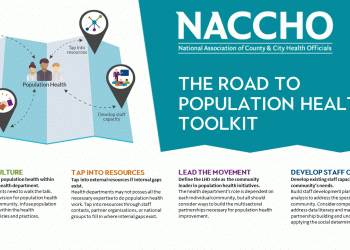



Local Health Department-Community Health Center Collaboration Toolkit
The Local Health Department-Community Health Center Toolkit is a set of tools designed to support collaborations between local health department (LHDs) and community health centers (CHCs) to increase access to and quality of critical services for underserved populations. The toolkit contains three tools along with a description on how to use each and a list of related resources. It aims to help LHDs and CHCs work together so that they can make more effective use of limited resources and help make healthcare work better for everyone. Please download the tool HERE.
Cross Jurisdictional Sharing of Services
Cross-jurisdictional sharing of services is a term used to refer to the wide variety of means by which jurisdictions can collaborate around the provision of public health services. Local health departments (LHDs) across the country are looking to cross-jurisdictional sharing as a way to help them more efficiently and effectively deliver public health services.
The Center for Public Health Sharing, a national initiative managed by the Kansas Health Institute with support from the Robert Wood Johnson Foundation, is currently supporting a learning community of 16 teams across the country, comprised of public health agencies, policymakers, their partners and key stakeholders that are collaborating to strengthen their ability to provide public health essential services, improve efficiency and control costs.. These teams are exploring how cross-jurisdictional sharing might help them fulfill their mission of protecting and promoting the health of the communities they serve. For more information about the Center for Public Health Sharing, as well as access to resources, visit http://www.phsharing.org.
With funding from the Robert Wood Johnson Foundation, NACCHO previously worked with Kansas and Massachusetts to develop and consider regional models in order for LHDs in each state to more efficiently and effectively provide public health services. An evaluation details the work that was accomplished and provides lessons learned in each state as a result of their experiences.
Tip Sheet: Partnerships between LHDs and Faith-Based Organizations
Local health departments and faith-based organizations partner together around many public health concerns. In 2016, NACCHO interviewed both groups in an effort to understand how to leverage the capacity of these partnerships to improve the health of the community. View the tip sheet on working together here.
For more information, please email [email protected].
Introduction to Virtual Facilitation Guide
As NACCHO and our members adjust to teleworking during the COVID-19 response, we are all navigating new territory when it comes to finding virtual alternatives for in-person collaboration. To address this challenge, NACCHO has identified some resources, strategies, and tools that local health departments and their partners can use to design and facilitate virtual collaborative activities. Read the guide here.