Synopsis
Mechanical repair is a quintessential “getting your hands dirty” job. Professionals at repair shops are constantly handling parts and products saturated in chemicals, some of which can be harmful if not carefully handled. Those chemicals can include degreasers, which are cleaning products used to break down stubborn greases, grimes, residues, and other contaminants.
Solvents are added to degreasers to enhance their cleaning power, and they often evaporate quickly at room temperature. These substances can contribute to both indoor and outdoor air pollution. Auto repair workers may inhale these substances or come into contact with them on their skin.
Challenge
Many traditional degreasers contain hazardous chemicals that increase health risks when people are exposed to them. While the workers who use degreasing products are most at risk, everyone in the surrounding community can be exposed to small amounts as the uncontained chemicals escape from the workplace.
Exposure to these chemicals can cause negative short-term effects like skin rashes, slowed reactions, fatigue, dizziness, or headaches. Long-term exposure can cause damage to the kidney, liver, or nervous system, and increases the chance of cancer.
The Haz Waste Program also connects businesses with a similar statewide incentive program operated by the Washington State Department of Ecology. Their voucher program offers 100% reimbursement, with the total amount ranging from $1,000 to $10,000 in expenses. The largest reimbursements are given for the safest products.
Solution
In 2021, to help reduce exposures to some of the worst chemicals used in degreasers, Washington state’s Hazardous Waste Management Program in King County (Haz Waste Program) launched a new project to promote safer degreasing methods, adapting approaches developed by the Washington State Department of Ecology. The Haz Waste Program applied a racial equity lens to choose degreasers as a focus. Our analysis determined that the communities most vulnerable to hazardous chemicals were also more likely to be exposed to hazardous air pollutants at work.
The Haz Waste Program’s experts advise businesses on a range of choices they can make to reduce exposure to hazardous degreasers based on their unique operational needs. These individualized business consultations are a complementary, in-person service of the Haz Waste Program. The Program doesn’t endorse any products or evaluate their performance. Businesses may consider a variety of safer product options, listed below in order from safest to more hazardous:
- Safest: Water-based products certified by the U.S. Environmental Protection Agency’s Safer Choice program
- Water-based products (after review for chemicals of concern. Chemicals of concern include perchloroethylene, toluene, hexane, methanol, and chemicals listed on the EPA Hazardous Air Pollutants list.)
- Solvent-based products (after review for chemicals of concern); may or may not include canisters with refilling stations to replace disposable aerosol cans
To help businesses make the switch to safer replacement products and methods, the Haz Waste Program offers two financial incentives:
- Safer products that businesses can try at no cost
- Vouchers providing 75% reimbursement up to $5,000 to eligible businesses for the costs of switching to safer replacement products and methods
The Haz Waste Program also connects businesses with a similar statewide incentive program operated by the Washington State Department of Ecology. Their voucher program offers 100% reimbursement, with the total amount ranging from $1,000 to $10,000 in expenses. The largest reimbursements are given for the safest products.
The Haz Waste Program publicizes its degreaser initiative using a variety of strategies, including social media promotions and in-language campaigns in local ethnic media outlets. Outreach materials were produced in English and transcreated in Spanish, Korean, and Russian. The Program strives for equity in its outreach efforts, ensuring the people most likely to be affected by hazardous degreaser chemicals are prioritized.
The Haz Waste Program applies approaches like targeted universalism, environmental health disparities analysis, and results-based accountability to deliver services and monitor performance of the initiative.

Results
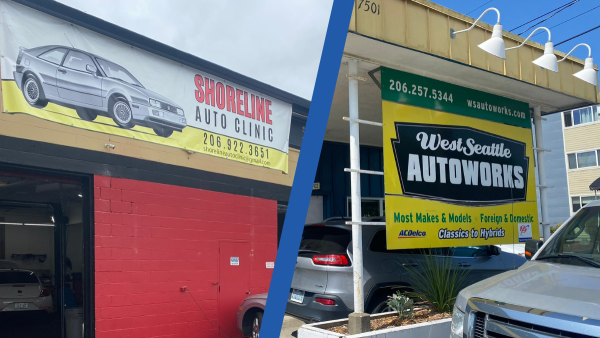
To examine its initiative to help businesses shift to safer degreasers, the Haz Waste Program talked to two automotive repair shops that have been working with Program experts.
Shoreline Auto Clinic
After managing an auto center in Shoreline for several years, in 2021, Jori Wink partnered with a property owner to open Shoreline Auto Clinic. From the very beginning, Wink has been committed to running a clean shop.
An early visit from the Haz Waste Program helped guide best practices for his new business. Right away, Wink was interested in the Program’s degreaser project. Wink was particularly intrigued by a machine that uses ultrasonic vibrations to shake the gunk off automotive parts in a tub of water. This is a less toxic approach to degreasing parts, but Wink had a practical reason for his interest in ultrasonic cleaning.
“It works,” Wink says. “Before, you would spend 40 hours fixing and resealing an entire motor, but we wouldn’t really have a way to make it so that the metal is shiny again. This is something that helps get all the dust and grime and oil and everything else out of those cracks that you can’t really get to otherwise, because it just breaks it loose with the ultrasonic. It’s very effective.”
On top of being effective, it’s also cost-efficient. Before the ultrasonic cleaner, Wink guesses about $300 worth of brake cleaner was needed to do the same job, and his shop was using a case or more of the stuff every week.
The Haz Waste Program helped Shoreline Auto Clinic cover most of the cost of its ultrasonic cleaner. Wink estimates his business paid only $1,000 for the machine’s $4,400 price tag. “We use it probably at least five times a week. In three or four months, it was paid for.”
Wink has no love lost for the toxic brake cleaners his shop used to churn through.
“It’s way more hazardous to the people inside the shop, also the environment with the waste that comes with it,” Wink says. “It’s pretty bad. Like, if you’re spraying it in the shop, you have to be ventilating it or else you’ll start to hear colors, you know what I mean?”

West Seattle Autoworks
West Seattle Autoworks opened its bay doors to customers in 2010. Owner Chris Christensen says he has always had an interest in establishing environmentally friendly practices at his shop. But it was an unusual mishap that forced Christensen to explore new degreaser options.
“We had a break-in,” he says. “They rammed the door, and the parts washer exploded. So that’s what prompted me. I said, ‘OK, I want to get something better in here.’”
Christensen reached out to the Haz Waste Program for guidance, and the Program connected his business with vouchers to help pay for a new washer. The new system employs a washing process called “bioremediation,” which uses microbes to break down oil and grease. This process requires minimal energy usage. Maintenance is limited to replacing filters and adding a mixture of water and cleaning solution. Old filters can typically go in the regular trash.
Christensen says he was hesitant about investing in the bioremediation washer at first, noting that he had used an earlier model years ago and had issues. But he says manufacturers have made great strides since then, and it shows.
“I’ve had no issues whatsoever,” Christensen says. “It’s going to give you the same result with very few of the harmful effects. We don’t have to use any (personal protective equipment) with this. We do, but we don’t have to, because it’s not caustic.”
Lessons Learned
Through expert advice and thousands of dollars in financial support, small businesses can be encouraged and persuaded to make the switch to safer products and equipment. In the process, many businesses are pleased to discover that switching to safer degreasers can be cost-efficient and minimally disruptive to operations.
Resources
- Flyers: English: biz-safer-degreasers-english.pdf | Korean: biz-safer-degreasers-korean.pdf | Russian: biz-safer-degreasers-russian.pdf | Spanish: biz-safer-degreasers-spanish.pdf
- KCHD’s suite of outreach materials can be found here: Hazardous Waste Management Program document library - King County, Washington
- Blog post: King County businesses are switching to safer degreasers. Here’s how the Haz Waste Program can help.
- Blog post: Ways to stay safe when degreasing and cleaning auto or machine parts
- Website: Automotive degreaser replacement program – Washington State Department of Ecology
- Website: Safer Choice – Environmental Protection Agency
- Website: CleanerSolutions Database – Toxics Use Reduction Institute
Contact
Alice Chapman
Health and Environmental Investigator, Haz Waste Program
[email protected]
Justin Meyer
Health and Environmental Investigator, Haz Waste Program
[email protected]
Images courtesy of King County’s Haz Waste Program.