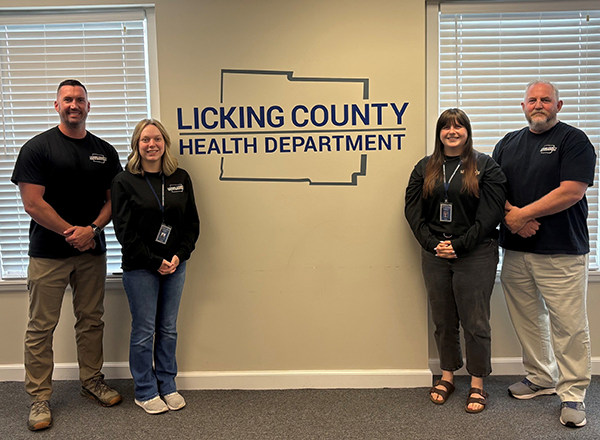
For more than 20 years, no Ohio local health department achieved Project Public Health Ready (PPHR) recognition. The Licking County Health Department (LCHD) changed that, becoming the first to receive the distinction this year. The idea to apply started with the Health Commission Chad Brown who saw the opportunity not only to be first in the state, but to spotlight the department’s preparedness and response capabilities.
PPHR is a nationally recognized, criteria-based training and recognition program developed by NACCHO in partnership with the Centers for Disease Control and Prevention (CDC). It is designed to help local health departments (LHDs) develop core public health and emergency preparedness competencies. Health departments that successfully complete the program earn PPHR recognition, valid for five years.
Home to a little over 180,000 residents, Licking County sits directly east of Columbus. The health department has about 60 staff with four supporting preparedness. The team includes Planning and Preparedness Manager Adam Masters, two epidemiologists, and an emergency response coordinator who also serves as a PIO. Each was involved in the PPHR application process.
“The PPHR application gave us the push to update and develop plans,” said Masters. “It also gave us the opportunity to document the lessons learned during COVID-19 response and the hard work that we do every day.”
In going through the application, the team identified where they were the primary and where they played more of a support role in planning and response.
“We rely on our partnerships,” said Masters. “The emergency management agency and hospital are key partners. When we met, we would talk about PPHR.”

Adam Masters at a point of dispensing (POD) with Licking County Emergency Management Agency (EMA) dispensing box fans to residents in the summer for extreme heat.
During the application process, the department pushed itself to collaborate and do different types of Points of Dispensing (PODs) that aren’t around medical countermeasures. For example, they worked with emergency management to distribute box fans when the county was faced with high temperatures.
“The exercise was well received,” said Masters. “It helped us to have a presence in the community and to build trust.”
PPHR emphasizes collaboration with community partners and exercising response plans. Implementing the box fan distribution exercise allowed the department to strengthen partnerships and increase community visibility; two key outcomes of preparedness planning.
Another example of the team putting its newly updated plans into action was around its continuity of operations (COOP) plan, which had been developed using a power loss scenario. The team experienced a new emerging threat, a cyberattack, which disrupted normal day-to-day activities and forced staff to get creative to maintain functions like epidemiology.
“The attack gave us new ideas of what to look for and be prepared for,” said Masters. “We saw vulnerabilities. The experience had us building on the foundations that we have for COOP to chart core pieces of planning and create more depth through cross trainings.”
One of the core principles of PPHR is continuous quality improvement. The cyberattack served as a real-world test of the department’s preparedness plans, allowing staff to identify gaps, refine procedures, and enhance future planning efforts.
The team has also put its newly reviewed and updated plans into action in response to measles cases and addressing travelers from Ebola-impacted areas.
In terms of advice for other health departments considering applying to PPHR, Masters recommends looking at your team and having stability in place before beginning the process. He also notes a need to ensure community partnerships are in place and to tackle new and emerging threats head on.
“PPHR is worth the time,” said Masters. “It was two years and a lot of hard work. It was extremely beneficial.”
Ready to demonstrate excellence in planning for, responding to, and recovering from public health emergencies? Celebrate your commitment to building stronger communities. Click here to learn more about PPHR, including details of the application process and ways to get involved in the program as a reviewer, state lead, or workgroup member. Interested in a one-on-one connection or staying in the loop about program updates? Click here.