MAPP 2.0 & Assessment Background
Mobilizing for Action through Planning and Partnerships (MAPP) is NACCHO’s flagship framework for community health improvement, a community-driven strategic planning process to address population health issues. Facilitated by public health leaders with cross-sector partners and community members, MAPP helps communities apply strategic thinking to conduct a community health assessment (CHA), prioritize public health issues and identify resources to address them through a collaborative community health improvement plan (CHIP). MAPP 1.0 was released in 2001 and updated in 2023 to MAPP 2.0 based on findings from a national evaluation. Read more about MAPP 2.0 on our webpage – www.naccho.org/mapp.
NACCHO provides a variety of resources to support health departments with MAPP 2.0 implementation:
The MAPP 2.0 guidance includes: a Handbook outlining the complete three-Phase process, a Starting Point Assessment to guide continuous quality improvement, three tools for the CHA, and a Power Primer with activities to increase community power through MAPP
The MAPP Network Virtual Community hosts various resources including:
Open Forum Discussion Board for MAPP communities to connect
CHI Webinar Warehouse of recommended webinars and asynchronous
MAPP trainings Tool Repository of templates and references related to CHI
CHIP Strategy Bank with examples of actions communities have taken to address CHIP priorities
CHIP Member Exchange with CHIPs submitted by LHDs
NACCHO leads periodic in-person trainings to prepare participants to implement MAPP
The quarterly virtual Learning Community is an opportunity for MAPP Network members to practice MAPP activities and engage with examples from the field
With MAPP 2.0 in the field for just over two years, NACCHO conducted a nationwide survey and 15 interviews to examine how MAPP 2.0 users have been implementing the process and to understand field needs. The overall findings and main themes are presented in this brief.
Key findings
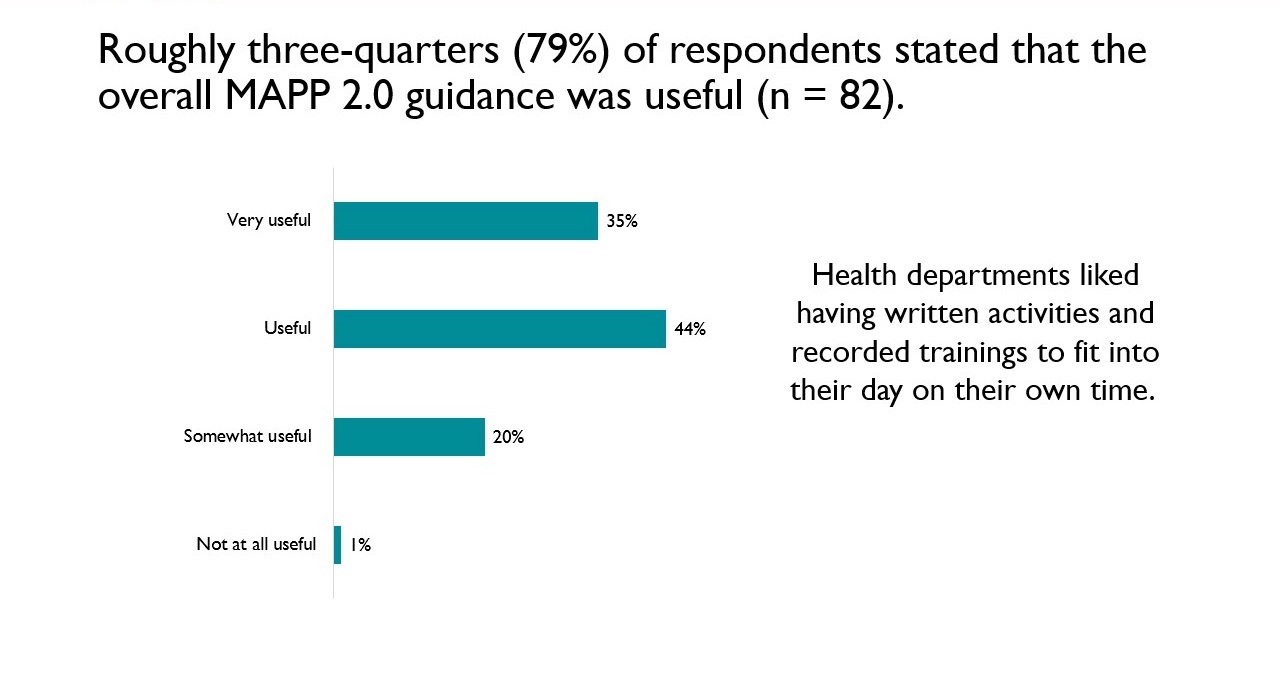
Respondents stated that in-person trainings, the tool repository on the MAPP Network Virtual Community, and overall MAPP 2.0 guidance were useful in implementing MAPP 2.0 for their community health improvement process.
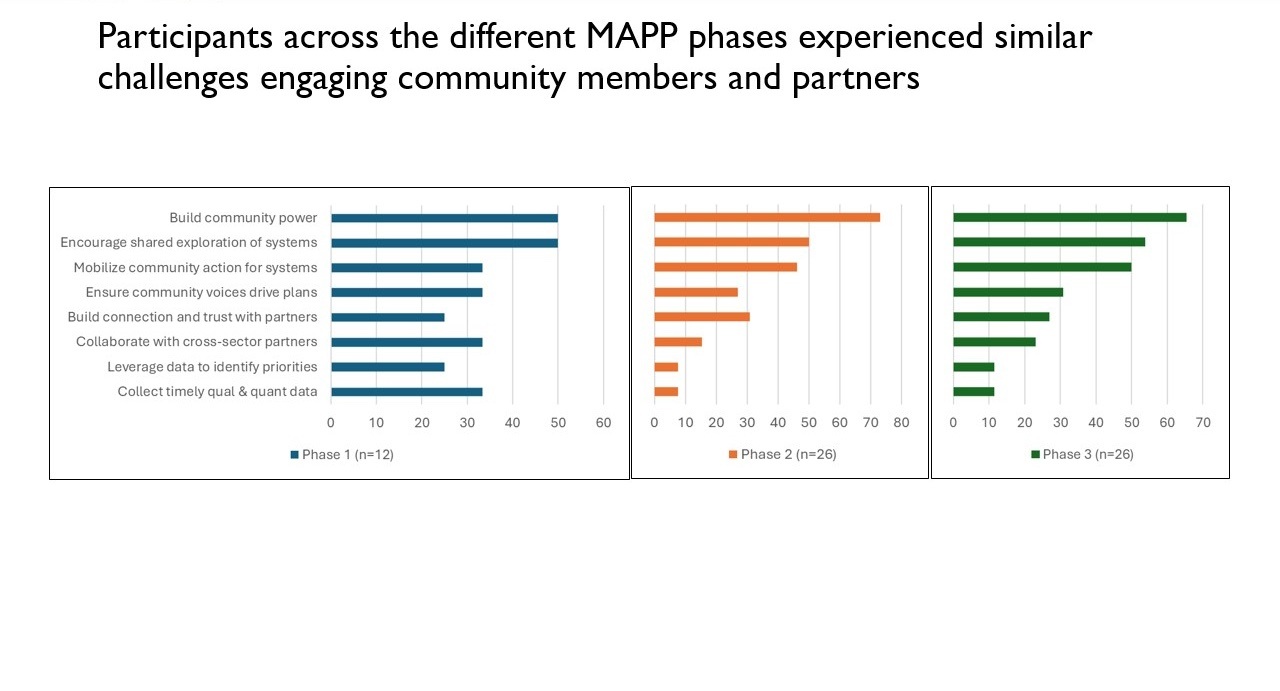
The primary challenge faced by health departments conducting CHAs or improvement activities was authentically engaging community members to gather their input and guide the development of solutions.
Health departments found it difficult to engage residents and cross-sector partners to own and implement interventions that require systems level changes.
Usefulness of MAPP Training Resources
In-person and virtual (asynchronous) trainings both had strong attendance with health department staff noting asynchronous trainings (available on the MAPP Network) allowed them to revisit topics and learn on their own time. NACCHO provided MAPP 2.0 in-person trainings to over 750 individuals from 2024-2025 and the asynchronous trainings collectively have over 1,800 views.
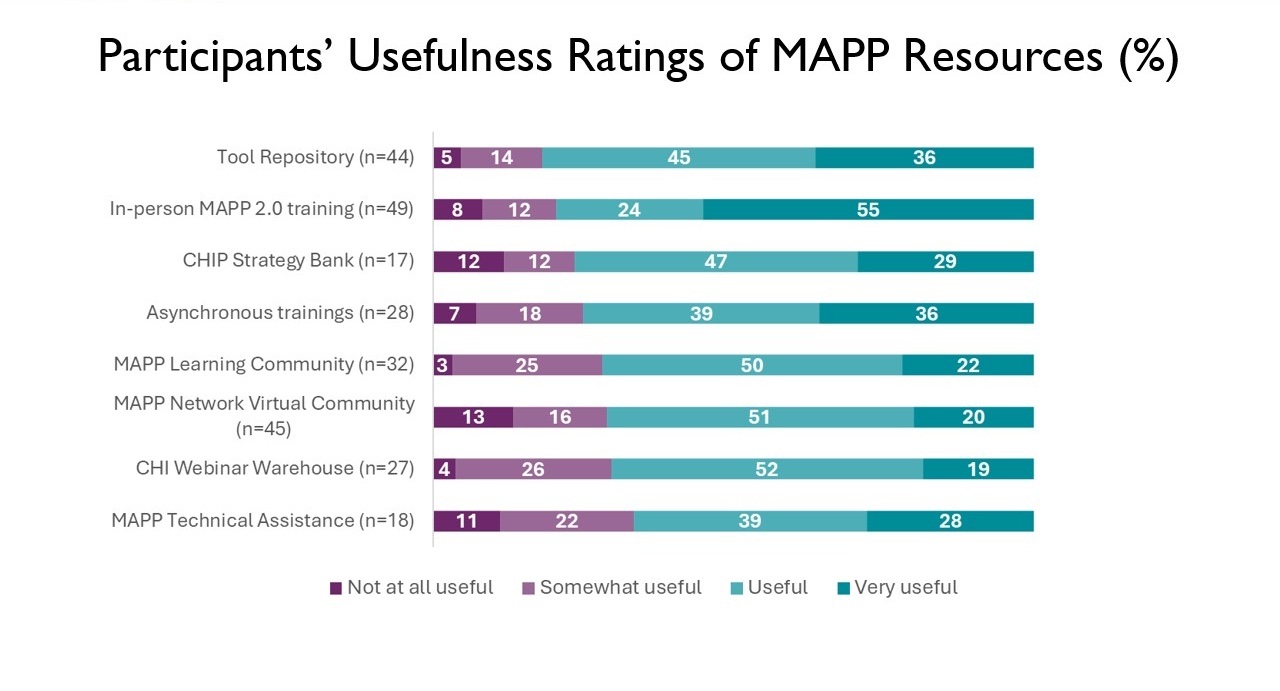
Over 65% of respondents that used specific MAPP 2.0 trainings, tools, and resources found them “useful” or “very useful”. Additionally, two-thirds of MAPP 2.0 users reported that the tool repository, in-person trainings, CHIP strategy bank, and asynchronous trainings were “useful” and “very useful”.
Challenges Reported with the Community Health Improvement Process
Survey respondents indicated which of the three phases of MAPP they were currently working on and ranked their top three challenges from a list. The three phases are:
Phase 1: Build the Community Health Improvement Foundation, when community organizations, groups, and residents are invited to collaborate on MAPP, create a vision for their work, and prepare for the process.
Phase 2: Tell the Community Story, when the CHA is conducted using three mixed-methods tools to gather comprehensive and timely data.
Phase 3: Continuously Improve the Community, when the community selects priorities for the CHIP, and community partners implement the CHIP to make progress on the selected issues.
The list of challenges was based on the MAPP 2.0 Foundational Principles, which underscore core components of a MAPP 2.0 process.
Interview respondents provided further detail into these challenges:
Availability of staff and community engagement proficiencies – Health departments have limited, if any, funds directly allocated for community events or purchasing incentives to increase community participation in community health improvement activities. Restrictive grants and siloed funding mechanisms make it difficult for health departments to assign staff time to community outreach not directly related to a program. At the same time, staff may not be familiar with community engagement approaches or have expert knowledge of tools that can optimize data analysis and data storytelling (e.g., tableau, ArcGIS, Power BI, etc.).
Community burnout – Community members are skeptical that their participation will lead to change or address their immediate concerns. Health departments need to build and strengthen trust and transparency in the community health improvement process to counteract years of extractive research practices that did not benefit the lives of community residents.
Networking and maintaining relationships with stakeholders – Health department staff often engage with hospitals, universities, community centers, and other critical partners when it’s time to collect data or implement a project. This has led to partnerships that feel transactional and rushed, making it difficult to align goals and strategies over the long-term. Health departments need the buy-in and constant support of partners to reach community members, develop systems-level solutions, and sustain community programs that build a culture of health.
Participant Recommendations for Supplemental MAPP Resources
Participants recommended the following to supplement their MAPP process.
A summary of best practices for engaging and sustaining relationships with community members and community organizations (e.g., how to promote community surveys and focus groups, build committees to help MAPP work, sustain cross-sector partnerships).
Guidance on how to find, evaluate, and implement evidence-based strategies or interventions.
Guidance on the ethical use of data (e.g., information on sample size, data sharing, avoiding duplication of surveying, etc.)
Frameworks and approaches to facilitation for brainstorming, consensus building, and crowdsourcing feedback.
An online space for health departments to discuss challenges with each other and share strategies.
NACCHO’s Next Steps
NACCHO is actively working to address the challenges and respond to the recommendations identified in this needs assessment through resources, trainings, and technical assistance. This year, NACCHO is providing the following resources to help meet identified needs:
MAPP 2.0 Trainings: Learn more and register for a two-day training at www.naccho.org/mapp. Our schedule for this year is:
March 17 & 18, 2026 – Washington, DC
April 14 & 15, 2026 – Baltimore, MD
MAPP Learning Community: NACCHO is bringing new topics and opportunities for engagement in our quarterly Learning Community. Join the MAPP Network using these instructions to learn more and register, and to access resources from prior sessions. Our scheduled sessions and topics for this year are below. Registration opens six weeks prior to each session for one week:
Jan. 21, 2026: Incorporating transformational, evidence-based strategies into your CHIP
April 22, 2026: Innovative funding to support CHIP priorities
July 8, 2026: Collaborating with clinical partners on your community health planning activities
If you are interested in bringing a MAPP training to your community, email [email protected].
Additionally, NACCHO will work to meet the recommendations brought forth from the needs assessment including providing information on best practices for community and partner engagement, evidence-based interventions, ethical data use, and group facilitation. NACCHO will continue to support the MAPP Network as a space for peer connection and resource sharing.
If you have questions or feedback on the MAPP process, please email [email protected].
Acknowledgements
Thank you to the many health department staff who participated in the needs assessment survey and interviews.
This report was supported by grant # 1NU38PW000037-01-00 awarded to the National Association of County and City Health Officials and funded by the Centers for Disease Control and Prevention. The contents of this report are solely the responsibility of the authors and do not necessarily represent the official views of the Centers for Disease Control and Prevention or the U.S. Department of Health and Human Services.