One Health framework

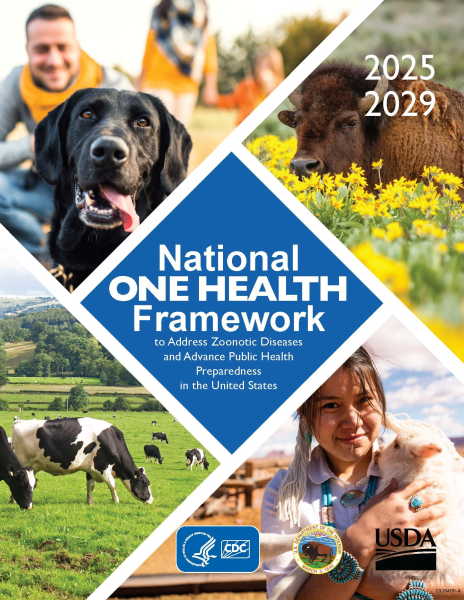
National One Health Framework to Address Zoonotic Diseases and Advance Public Health Preparedness in the U.S.

Jan 22, 2025 | Anu Varma

The Centers for Disease Control and Prevention (CDC), the U.S. Department of Agriculture (USDA), and the Department of the Interior (DOI) released the first ever National One Health Framework to Address Zoonotic Diseases and Advance Public Health Preparedness in the United States (NOHF-Zoonoses).

About the One Health approach

Everyday, the world sees examples of diseases spreading between humans, animals, plants, and the shared environment in which they live such as the ongoing H5N1 bird flu multi-state outbreak. The coordination of local, regional, national, and global organizations across public health, health care, epidemiology, and veterinary, environmental health, and agricultural sciences, among others, are required to address health and ecosystem threats across the spectrum.

The national framework will serve as a roadmap for the next five years (2025-2029) to enhance federal coordination and collaboration, inform policies, and improve preparedness and response capabilities in the United States. While this framework focuses on One Health coordination at the federal level, its success depends on robust partnerships with state, local, tribal, and territorial agencies, non-governmental organizations, academia, and private sector partners as well as collaboration with relevant international partners to address the seven strategic goals outlined in the framework:

  • Goal #1: Coordination, Collaboration, and Communication - Establishing a formal unit as a common platform and governance structure for addressing One Health needs
  • Goal #2: Prevention - To identify and strengthen new and existing opportunities to prevent, detect, and respond to zoonotic diseases
  • Goal #3: Preparedness - Strengthening collaborations for preparedness to address existing, emerging, and re-emerging health threats
  • Goal #4: Coordinated Outbreak Investigation, Response, and Recovery - To strengthen approaches to these outbreak investigation elements across relevant sectors
  • Goal #5: Surveillance - To strengthen capacity for surveillance and information sharing on disease threats across sectors
  • Goal #6: Laboratory: Strengthen One Health laboratory - Alongside coordination, research, and lab reporting capabilities for detection of zoonotic disease threats and other One Health issues
  • Goal #7: Workforce - To support and expand a qualified One Health workforce

NACCHO’s Work in One Health

  • Local Health Department’s One Health Surveillance Approaches to Antimicrobial Resistance - NACCHO spoke with two LHDs, the Chicago Department of Public Health (CDPH) and the New York City Department of Health and Mental Hygiene (NYC DOHMH), to learn how each LHD has taken a One Health approach to tackling AMR in their community.
  • Podcast From Washington: One Health - Dr. Mary-Margaret Fill, Deputy State Epidemiologist for the Tennessee Department of Health discusses the importance of integrating One Health in ongoing prevention, detection, preparedness, and response initiatives and how local public health professionals can incorporate One Health in their planning and response activities.


NACCHO logo small version02 square N pms321 Invert

About Anu Varma

Pronouns: She/Her

Anupama Varma is a Communications Specialist for Environmental Health at NACCHO.

More posts by Anu Varma

Related Posts

Drowning prevention
  • Healthy Living & Prevention, Model Aquatic Health Code, Water Quality

Drowning Prevention: A Quick Guide for Health Departments and Pool Operators

A tool for understanding important recommendations on preventing drowning based...

Jul 09, 2026 | Anu Varma, Aliya Al-Sadi

Drowning Prevention: A Quick Guide for Health Departments and Pool Operators

Sftf archuleta co
  • Extreme Weather, Rural and Frontier Health, Rural Health, Success Story

Building Rural Weather Resilience

Archuleta County Public Health partnered with the Pagosa Springs Community...

Jun 23, 2026 | Lacy Capre, Archuleta County Public Health, Colorado

Building Rural Weather Resilience

Pulsenet30 2
  • Food Safety & Inspection

30 Years of PulseNet USA: A CDC Milestone

How local health departments can recognize this landmark resource on June 30,...

Jun 23, 2026

30 Years of PulseNet USA: A CDC Milestone

Wastewater mentorship
  • Funding Opportunity, Mentorship, Wastewater

Request for Applications: 2026-2027 Wastewater Monitoring Mentorship Program

Deadline extended! Submit applications and all supporting materials no later...

Jun 18, 2026 | Rebecca Rainey

Request for Applications: 2026-2027 Wastewater Monitoring Mentorship Program

EH Gateway card v2
  • Model Aquatic Health Code, Webinar

MAHC Network Webinar: Introducing the EPH Practice Gateway

Hear from CDC on a new repository of evidence-informed practices and tools on...

Jun 10, 2026 | Aliya Al-Sadi

MAHC Network Webinar: Introducing the EPH Practice Gateway

Wwm summit card
  • Emerging Public Health Threat, Infection, Prevention, and Control, Infectious Disease, Influenza

Register Now: 2026 Wastewater Disease Surveillance Summit

Virtual registration is still open. Reserve your spot now.

May 27, 2026 | Rebecca Rainey

Register Now: 2026 Wastewater Disease Surveillance Summit

Sin nombre virus card
  • ID Featured, Tools & Resources

Sin Nombre Hantavirus vs. Andes Hantavirus

Learn about distinctions between the Andes virus and the Sin Nombre virus,...

May 20, 2026

Sin Nombre Hantavirus vs. Andes Hantavirus

Ci workshop
  • NACCHO 360

Workshop: Standardizing HCRAs for Local Action

A NACCHO360 preconference interactive workshop on climate and health risk...

May 20, 2026

Workshop: Standardizing HCRAs for Local Action

Ci tuczon AZ 1
  • Emergency Response, Emerging Public Health Threat, Extreme Weather, Infection, Prevention, and Control

Infection Prevention in Cooling Centers During Extreme Heat

A Heat Safety Week post from University of Arizona and Pima County Health...

May 20, 2026 | Royani Saha, University of Arizona, Mel and Enid Zuckerman College of Public Health, Betsy Camara, Pima County Health Department, Office of Heat Relief and Response, Nate Young, Pima County Health Department, Office of Heat Relief and Response, Mona Arora, University of Arizona, Mel and Enid Zuckerman College of Public Health

Infection Prevention in Cooling Centers During Extreme Heat

Back to Top