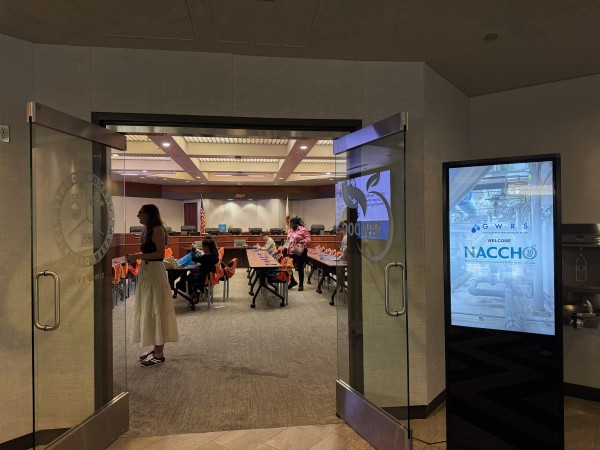
On July 14, 2025, the National Association of County & City Health Officials (NACCHO) convened more than 85 attendees and speakers for a full-day pre-conference wastewater monitoring (WWM) workshop at the 2025 NACCHO360 Annual Conference in Anaheim, California. The workshop, From Sewers to Solutions: Wastewater Monitoring for Public Health Action, featured presentations and panel discussions from subject-matter experts across the WWM field, including representatives from laboratories, wastewater utilities, and local, state, and federal health agencies. On July 15, more than 30 of the workshop attendees had the opportunity to visit and tour Orange County Sanitation District and Water District facilities. Keep reading below to learn more about the workshop and tour.
Highlights

Workshop attendees listen to a presenter during the Future Considerations for Wastewater Monitoring panel.


Tour attendees learn about the process behind the Orange County Water District’s Groundwater Replenishment System.
To see more photos, click here.
Wastewater Monitoring
WWM is a population-level public health tool that analyzes wastewater to detect and track infectious diseases within a community. When used alongside other forms of disease monitoring, it can provide a more comprehensive picture of community-level disease trends and help inform timely public health actions and decision-making. Local health departments (LHDs) have been at the forefront of the development and expansion of WWM, using it to monitor for pathogenic and non-pathogenic targets, such as SARS-CoV-2, influenza A and B, Respiratory Syncytial Virus, Mpox, opioids, and more. As a public health tool, WWM is interdisciplinary and requires LHDs to partner with wastewater utilities, laboratories, and other community partners for success. There is no single standardized approach to conduct or use WWM for public health action. This highlights the importance of creating opportunities for LHDs and other partners to meet, engage, and share best practices, tools, and more for successfully building and strengthening WWM programs at the local level.
Workshop
The workshop featured four moderated discussion panels, each addressing a key component of WWM. The opening panel, Foundations of Wastewater Monitoring, set the stage with an overview of the field, including background on the Centers for Disease Control and Prevention’s (CDC’s) Wastewater Program (NWSS), the role of wastewater utilities, and laboratory testing processes. Subsequent panels focused on sampling approaches, including upstream and utility-level collection methods, and strategies for generating actionable data through WWM testing and analysis. The final panel, Future Considerations for Wastewater Monitoring, encouraged a discussion on ethical considerations, new pathogen targets and assays, and the role of public-private partnerships in sustaining and expanding WWM.
In addition to the panels, attendees had multiple opportunities to engage in discussion-based exercises and networking helping to foster dialogue across disciplines. Attendees represented jurisdictions from across the country and varied in their level of WWM experience, jurisdiction size, and roles in conducting WWM.
Tours
The day after the workshop, more than 30 participants had the chance to continue their learning experience by attending a joint tour of the Orange County Sanitation District (OC San) and Orange County Water District (OCWD) in Fountain Valley, California. OC San provides wastewater collection, treatment, and recycling for more than 2.5 million people in Orange County, CA. Attendees were able to tour the grounds of OC San’s largest treatment facility and see the wastewater treatment process in action.
After touring OC San, attendees visited the nearby OCWD, a groundwater wholesale agency that manages and protects Orange County’s Groundwater Basin. In partnership with OC San, OCWD operates the Groundwater Replenishment System (GWRS), the world’s largest water purification system for indirect potable reuse. OCWD takes the treated wastewater from OC San and uses a multi-step treatment process to produce high-quality reusable water. Tour attendees were able to see each of these steps in action and even drink the treated water.
These tours allowed attendees to see the wastewater treatment process in action, providing greater context to the wastewater utility partners that are instrumental for the successful conducting of WWM. Many LHDs report that taking time to visit and engage with their local wastewater utility partners has strengthened their WWM program.
NACCHO and Wastewater Monitoring
NACCHO is committed to supporting LHDs in the development and expansion of their WWM efforts. Visit the NACCHO WASH webpage to explore a variety of wastewater monitoring resources, including a resource library, Community of Practice, and reports from past cohorts of the mentorship program.