Wastewater monitoring (WWM) is a population-level public health tool that analyzes wastewater to monitor community health and detect emerging threats. When used in conjunction with other forms of disease surveillance, it can paint a more comprehensive picture of community-level infections and help inform public health action. Local health departments (LHDs) use WWM to monitor for a variety of pathogenic and non-pathogenic targets, such as SARS-CoV-2, influenza A and B, Respiratory Syncytial Virus, Mpox, opioids, and more.
In 2022, the National Association of County and City Health Officials (NACCHO), with support from the Centers for Disease Control and Prevention (CDC), launched the Wastewater Monitoring Mentorship Program to match LHDs with demonstrated experience in WWM with LHDs in the early stages of developing WWM programs and seeking guidance, tools, and resources. The fourth cohort, launched in 2025, featured five mentors and 17 mentees. During the program, each mentor was matched with two to three mentees and provided tailored technical assistance to guide mentees in implementing their WWM programs. This assistance was delivered through one-on-one meetings, presentations, and site visits.
Mentors hosted each of their assigned mentees for an in-person or virtual site visit. The purpose of these site visits was to demonstrate WWM processes in action, allowing mentees to observe and learn. Site visit activities were developed based on the specific needs of each mentee and included presentations from subject-matter experts, tours of wastewater treatment plants, demonstrations of laboratory testing processes, and more. During the fourth cohort of the mentorship program, a total of 16 site visits were conducted.
Keep reading to learn about three of these site visits.
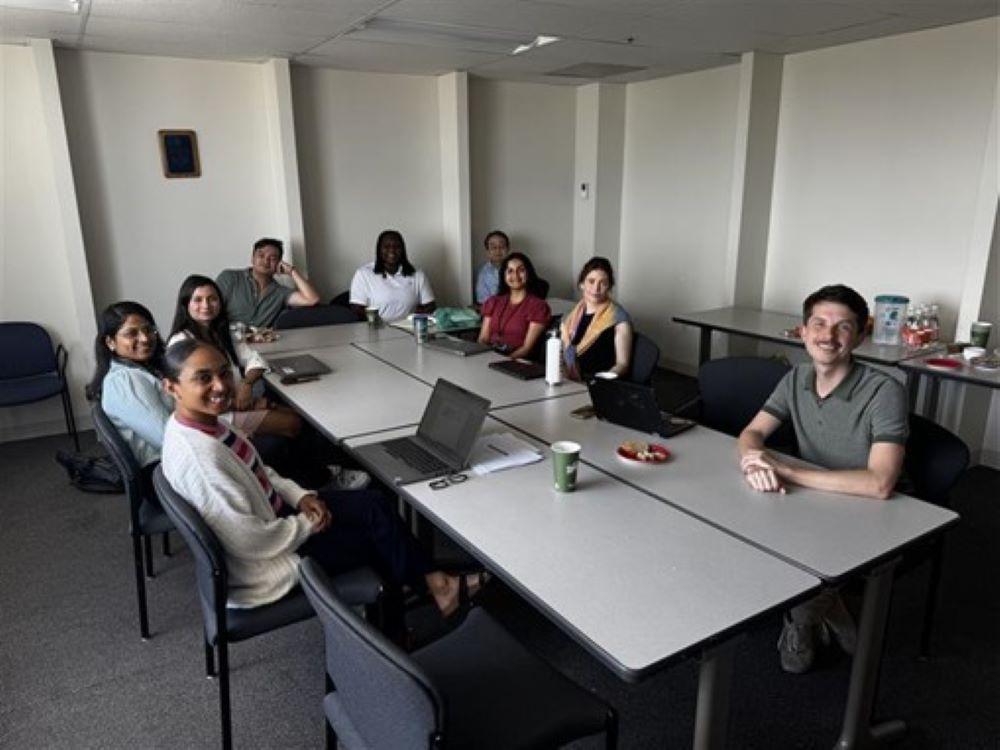
Harris County Public Health (HCPH) visits Boston Public Health Commission and discusses HCPH’s new wastewater monitoring dashboard.
Boston Public Health Commission (MA) and Harris County Public Health (TX)
On July 1, 2025, mentee Harris County Public Health (HCPH) visited their mentor, the Boston Public Health Commission (BPHC), at BPHC facilities in Boston, MA. For this one-day site visit, BPHC designed a dynamic agenda specifically tailored to the needs of HCPH. They brought together staff from across BPHC to meet with HCPH, gave presentations, and led guided discussions. The BPHC Education and Community Engagement Division of the Infectious Disease Bureau provided examples of how WWM data can be used for community education and action. The BPHC Associate Communications Director led a discussion on methods for communicating wastewater monitoring data through dashboards, social media, or media appearances. The BPHC GIS and Data Analysis team led an exercise with HCPH in which they reviewed and discussed HCPH’s new wastewater monitoring dashboard. At the end of the day, HCPH left the site visit with concrete ideas and next steps regarding the future of their program.
Lincoln-Lancaster County Health Department (NE), Cerro Gordo Department of Public Health (IA), and Union County Health Department (OH)
Mentor Lincoln-Lancaster County Health Department (LLCHD) hosted a two-day joint site visit for mentees Cerro Gordo Department of Public Health (CGDPH) and Union County Health Department (UCHD) on June 23 and 24, 2025, in Lincoln, Nebraska. On the first day of the site visit, LLCHD held a workshop featuring presentations from a variety of WWM partners, including the Nebraska Department of Health & Human Services, University of Nebraska – Lincoln, Lincoln Transportation & Utilities, and more. The workshop also included a facilitated discussion exercise to address mentees’ WWM implementation barriers and to discuss next steps. On the second day of the site visit, the mentor and mentees went on a guided tour of the Theresa St. Wastewater Treatment Plant, one of the two sites where LLCHD collects samples. While on the tour, the mentees had the opportunity to see the wastewater sampling process in action.

San Mateo County Health and County of San Diego Public Health Lab staff visit the San Mateo County Public Health Laboratory and view a demonstration of the wastewater testing process.
San Mateo County Health (CA) and County of San Diego Public Health Lab (CA)
On April 17, 2025, mentor San Mateo County Health (SMCH) hosted mentee County of San Diego Public Health Laboratory (CSDPHL) for a one-day site visit at their public health laboratory. The site visit began with a tour of the San Mateo County Public Health Laboratory and a demonstration of their wastewater testing process from start to finish. During this demonstration, CSDPHL saw how SMCH filters and concentrates a wastewater sample, completes nucleic acid extraction from the sample, and performs quantification and quality control. At the time of the site visit, CSDPHL was in the process of opening a new laboratory, and this testing demonstration was particularly valuable as they prepared to shift their wastewater testing from being conducted with external academic partners to being conducted at an in-house laboratory. The site visit finished with a presentation from the SMCH epidemiology team on data analysis and interpretation.
NACCHO and Wastewater Monitoring
NACCHO is committed to supporting LHDs in the development and expansion of their WWM efforts. Visit the NACCHO WASH webpage to explore a variety of wastewater monitoring resources, including a resource library, Community of Practice, and reports from past cohorts of the mentorship program.