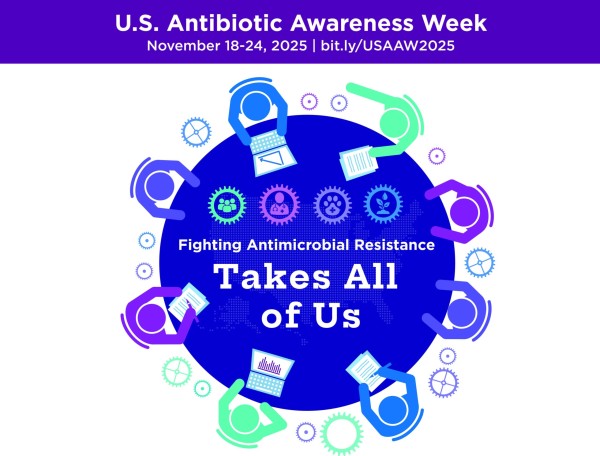
The Cincinnati Health Department and other public health, animal, agricultural, and environmental partners recently established a regional One Health Collaborative to address the rising threat of antimicrobial resistance. In recognition of U.S. Antibiotics Awareness Week (USAAW), NACCHO spoke with Tyler Parsons from the Cincinnati Health Department about their collaborative. The reflections and lessons are timely and poignant and align with the 2025 USAAW theme—that everyone has a role in fighting antimicrobial resistance—that we must use a One Health approach to fight antimicrobial resistance.
Building the Team
When building the Collaborative, our focus was clear: to bring together everyone with a stake in antimicrobial resistance. This includes a universe of stakeholders from healthcare, veterinary medicine, agriculture, and environmental sectors. We aligned our work with the World Health Organization’s One Health framework, and by doing so, we promote responsible antimicrobial use; enhance communication between sectors; and strengthen infection prevention and control efforts across Southwest Ohio. Our goal was to create a unified, evidence-based approach that reduces misuse of antimicrobials and protects the health of people, animals, and the environment.
The Cincinnati Health Department led public health coordination, and soon, other local health departments joined. Each contributed expertise in surveillance and response to outbreaks. We also brought in infection preventionists, public health nurses, veterinarians, pharmacists, dentists, and providers from primary care, pediatrics, and agriculture. Higher education institutions and The Health Collaborative joined as key partners, with a goal of strengthening connections between public health and healthcare systems.
To recruit members, we first used our existing networks. We shared invitations through our Bad Bug and Break the Chain newsletters. We also used our local APIC chapter and the Southwest Ohio Public Health Region’s REDI workgroup. Next, we launched a brief survey to gather input on infection prevention and antimicrobial stewardship priorities from various sectors. We followed up by reaching out personally to leaders in veterinary medicine, agriculture, dentistry, and pharmacy, which ensured diverse representation.
Our aim from the start was to make participation accessible to all, regardless of background or sector. Addressing antimicrobial resistance requires joint efforts, and the Collaborative fosters shared learning and practical problem-solving.
Setting the Goals
Our goals center on protecting human, animal, and environmental health. We seek to promote responsible antimicrobial use by supporting evidence-based prescribing and stewardship in all settings. We aim to enhance partner communication and strengthen infection prevention by providing targeted education and training to front-line staff.
Beyond that, we are developing shared data systems to track resistance and spot early patterns. We are also creating a sustainable framework with clear leadership and steady collaboration. This approach allows our work to evolve and support the One Health vision: a healthier, resilient region where all forms of health are connected.
Progress So Far
Our first major step in launching the collaborative was to form a steering committee that represented public health, healthcare, veterinary medicine, and higher education. This group helped to shape our mission, outline our goals, and determine how the Collaborative would operate.
We created and distributed a regional survey to gather direct feedback from partners. The feedback we received showed areas where collaboration could have the greatest impact. We also hosted our first steering committee meeting, where we discussed leadership roles, meeting logistics, and our next steps. We then elected a leadership committee that will meet routinely to help facilitate the action items identified during the Collaborative meetings.
We are currently finalizing our mission statement and defining three regional priorities for the coming year. Each step brings us closer to a fully functioning regional Collaborative. Our effort connects people and organizations throughout Southwest Ohio in a coordinated action against antimicrobial resistance.
Looking Ahead
Our next steps are to transform plans into action. We will finalize the mission statement and identify three regional priorities. Once these are set, we will develop detailed action plans for each, with measurable goals and timelines.
We are enhancing data sharing and communication among sectors to foster greater collaboration and make our efforts more efficient and impactful. Our goal is a transparent system for exchanging information on antimicrobial use and resistance across the region. Each sector benefits from this transparency by gaining actionable insights to refine practices, showing the mutual value of sharing data.
Membership and outreach will continue to expand, so all voices are represented. This work is just the beginning, as we build the foundation for lasting partnerships that protect the health of people, animals, and our shared environment.
Lessons Learned
Launching the Collaborative has been a learning experience from the start. The biggest lesson so far has been the value of starting small but thinking big. Antimicrobial resistance can feel overwhelming. Beginning with a clear mission, a few committed partners, and realistic goals, we were able to build momentum and credibility early on.
We also learned that relationships matter. The most productive conversations came from existing partnerships and personal outreach. Those one-on-one connections created a sense of shared ownership that broad invitations alone could not achieve.
Another key takeaway is that communication demands structure. Defining roles, making clear agendas, and following up after meetings made our process smoother and more effective. Having a Steering Committee with designated leadership has helped keep everyone organized and accountable.
Finally, we learned the importance of flexibility. Each sector has its own priorities and timelines, and finding common ground takes patience and collaboration. Allowing space for open discussion and shared decision-making has strengthened our work.
For other local health departments considering a similar approach, we encourage you to start by connecting with individuals who already work on the issue. Listen to their perspectives, identify your shared goals, and then build a structure that enables everyone to move forward together.
Final Thoughts
Building the One Health Collaborative has reminded me that real progress in public health rarely happens in isolation. It takes shared commitment and a willingness to move beyond traditional boundaries. Every partner who joins this work brings a unique perspective, and that diversity is our greatest strength.
What stands out most is the significant enthusiasm in our region for tackling antimicrobial resistance together. People are ready for collaboration that feels practical, coordinated, and results driven. Our goal is to sustain that momentum by creating a space where ideas are turned into action and partnerships yield measurable outcomes.
If there is one message I would share with others, it is this: you do not need to have everything figured out before you begin. Start the conversation, build relationships, and let the work grow organically. The One Health approach is not only about connecting sectors, but also about creating a shared sense of responsibility for the health of our entire community.
Learn more about antimicrobial resistance, One Health, and resources you can share in your community.
References
Ortiz, D. A., Legenza, L. M., Olson, B. J., Knapp, C. C., Killian, S. B., Meece, J. K., Hall, M. C., & Fritsche, T. R. (2022). Surveillance for multidrug resistant Escherichia coli carriage in cattle, dogs and humans reveals predominance of CMY-2, CTX-M-15 and CTX-M-9 groups of β-lactamases. Comparative immunology, microbiology and infectious diseases, 89, 101880. https://doi.org/10.1016/j.cimid.2022.101880
World Health Organization, Food and Agriculture Organization of the United Nations, World Organisation for Animal Health, & United Nations Environment Programme. (2022, April 6). Strategic framework for collaboration on antimicrobial resistance: Together for One Health (ISBN 978-92-4-004540-8). https://www.who.int/publications/i/item/9789240045408