Public health professionals work every day to keep communities safe, yet, too often, their efforts are met with scrutiny. Recent data show that even after the height of the COVID-19 pandemic, many local health departments (LHDs) still face harassment and backlash, adding another layer of strain to an already demanding profession. To better understand these experiences, NACCHO collected data about harassment and backlash targeting LHDs related to public health measures in the 2024 Forces of Change Survey. This nationally representative study was conducted in Spring 2024 to assess changes in LHD capacity and activities driven by emerging issues in public health.
While the majority of LHDs did not report harassment involving agency leadership or personnel, nearly one-third reported experiencing harassment in 2023 related to public health measures. Locally governed LHDs reported higher rates of harassment than LHDs with other governance types; however, a higher share of state-governed LHDs reported not knowing whether agency leadership or other personnel had experienced instances of harassment.
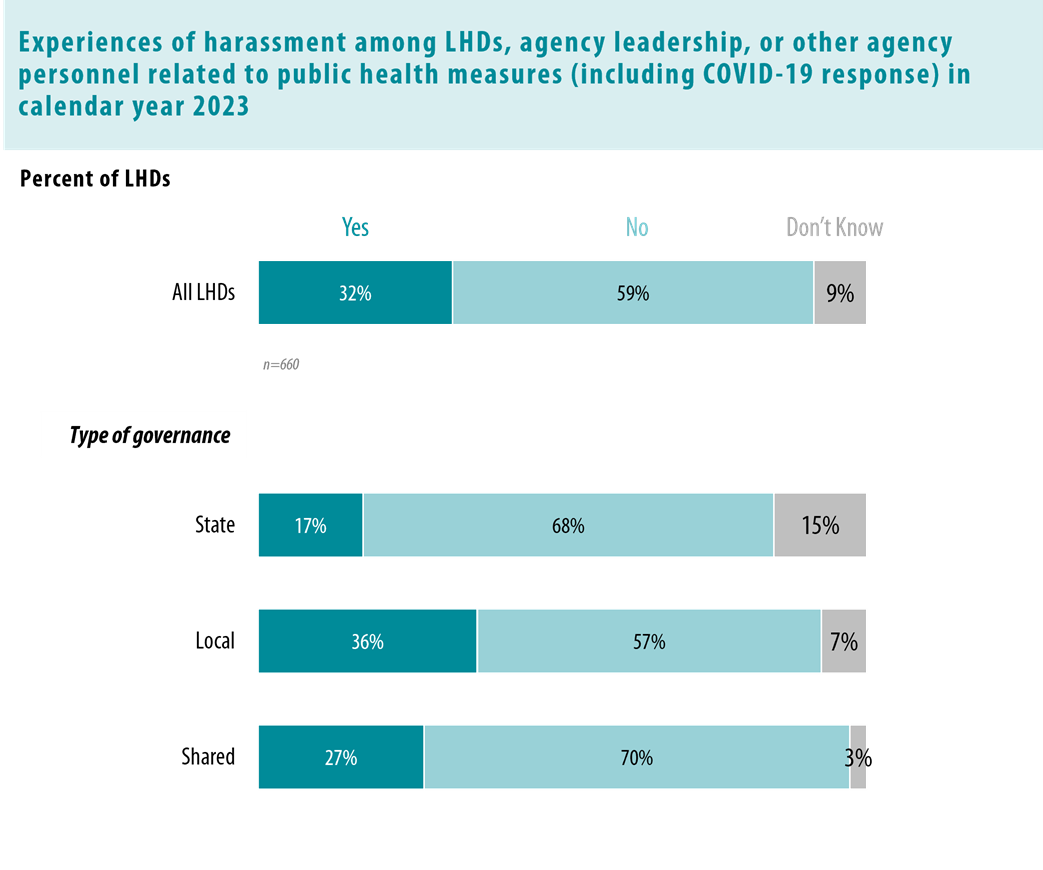
Between March 2020 and September 2022, seven in 10 LHDs reported harassment targeting their agency, leadership, or other personnel in response to COVID-19. Comparatively, three in 10 LHDs reported harassment related to public health measures (including COVID-19) in calendar year 2023. This trend held true for LHDs of each type of governance.

The most widespread type of harassment was via social media, with 32% of LHDs reporting this. Physical harassment (e.g., direct threats, public demonstrations, destruction of property) was less prevalent.
Nearly three-quarters of LHDs who had experienced harassment in 2023 did not receive any protections, and these LHDs were less likely to receive protections from any entity in 2023 than in 2022. For those that did receive protections, the most common form was through a local entity. State-governed LHDs were more likely to have received protections from a state or a local entity than LHDs with other types of governance. LHDs of different sizes also reported various levels of protections. While nearly half (47%) of large LHDs received protections from a local entity, only 15% of small LHDs reported the same thing.

Nine in 10 LHDs did not experience workforce disruptions in calendar year 2023 due to political pressure related to public health measures such as the COVID-19 response, and only 6% of LHDs reported resignations, reassignments and/or firings of leadership or staff. This result was consistent across LHD size and governance.
While harassment targeting LHDs appears to be declining since the early pandemic years, it continues to undermine the safety and stability of this essential workforce. Supporting LHDs with stronger protections and recognition not only safeguards professionals, but it also ensures every community can rely on a public health system that’s equipped to respond, adapt, and thrive in the face of future challenges.