In honor of National Preparedness Month, occurring annually each September, NACCHO recognizes the critical role that local public health agencies play in responding to public health emergencies across the nation. As leaders in public health prevention at the local level, local health departments (LHDs) are positioned to dedicate resources and implement strategies that meet the needs of maternal and child health (MCH) populations in their communities when public health threats emerge. NACCHO’s MCAH and Preparedness portfolio works to strengthen the capacity of LHDs to integrate MCH populations in emergency planning to prepare for future public health threats.
LHDs formed the backbone of the COVID-19 response and have worked diligently to address threats that have, and will continue, to impact our communities. While many public health threats disproportionately impact pregnant women and infants, emergency preparedness and response (EPR) practices do not always integrate and prioritize specific MCH population considerations.
Program Overview
In response to these needs, in 2021, NACCHO initiated the Virtual Learning Collaborative (VLC) for the Inclusion of Maternal-Child Health Populations in Emergency Preparedness and Response to help address gaps in EPR planning. This program was designed to cross-train MCH and EPR professionals at LHDs on integrating MCH considerations into emergency planning.
Over the last four years, the VLC consisted of training exercises and case study discussions in a peer-to-peer learning environment, helping LHDs strengthen their capacity to prioritize MCH populations in emergency preparedness, response, recovery, and mitigation activities. This program involved identifying improvements in MCH/EPR collaboration and the incorporation of MCH considerations in emergency planning at the local level, thereby improving public health response.
The VLC program consisted of one MCH and one EPR staff member from each LHD per cohort to ensure valuable collaboration and successful cross-training efforts. NACCHO engaged with the VLC to address the gaps identified and exacerbated by all-hazards events through training, technical assistance, and resources. Members of the VLC have been able to implement lessons learned by updating operational plans to incorporate the access and functional needs of MCH populations.
Lessons Learned and Impact
Earlier this year, a retrospective survey was conducted of the first three VLC cohorts to identify ongoing activities and resources being used. Out of the 21 sites that completed the survey, 95% of respondents identified areas of continued efforts to integrate MCH and EPR domains, including: improved internal collaboration between MCH and EPR; updated emergency plans to include MCH considerations; strengthened external MCH partnerships; increased training and outreach opportunities; and improved communication strategies. One respondent shared that “establishing relationships that will allow us to grow our capabilities to best meet the needs of children and families” was one of their proudest accomplishments.
Additionally, 90% of respondents highlighted ongoing use of the VLC curriculum materials to develop training modules for staff, create handouts for partner and community outreach, guide staff meetings and planning sessions, and integrate MCH considerations into emergency preparedness training. Respondents reported that external resources and tabletop exercises are used to identify gaps in current emergency plans, update emergency plans, and practice emergency scenarios, incorporate MCH needs into exercise discussions, and refine communication protocols, team roles, and staff education.
Follow-up informational interviews were conducted with three (3) LHDs to better understand the impact of the VLC. They reported that the VLC provided an opportunity for the MCH and EPR teams to meet and understand each other’s roles, fostering a positive working relationship and enabling future collaborations beyond this project. LHDs are updating their plans to better address the needs of MCH populations, and ongoing partnerships – both internally and externally – were established to increase collaboration across sectors. Participants highlighted that the VLC facilitated meaningful discussions between MCH and EPR teams, breaking down silos and helping to identify shared priorities. One participant described the VLC as a platform to “dream big” - “the real value for me is sharing best practices, continuing discussions, and growing knowledge”.
View the highlights from VLC Cohort 4 (2024-2025) via this infographic.
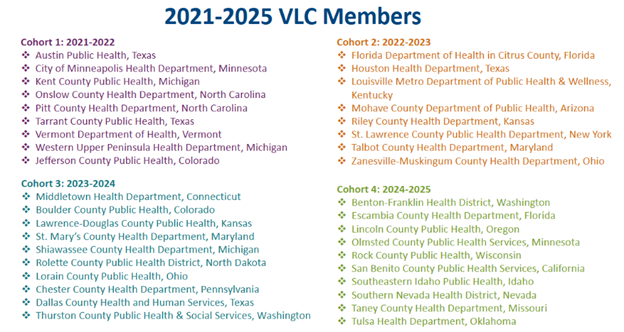
Virtual Learning Collaborative Membership
All participating members of the VLC across cohorts 1 through 4 are as follows:
Future Directions
NACCHO hopes to continue raising awareness and championing efforts that strengthen collaboration between MCH and EPR to ensure MCH populations are supported during all public health emergencies. Access our full repository of MCAH/Preparedness resources, tools, and materials here. For questions or more information, please contact Elana Filipos ([email protected]).